I'm in the home stretch to turn in my latest WIP (A Manhattan Heiress Goes to Paris, out in March!) by Monday. While I work on that, here's some fun things to read...

10 Paris hotels with fantastic views
I'm in the home stretch to turn in my latest WIP (A Manhattan Heiress Goes to Paris, out in March!) by Monday. While I work on that, here's some fun things to read...
10 Paris hotels with fantastic views
Well, it's been-- A Week, hasn't it?? Here are some things to read as you take a deep breath, have a cocktail, and start moving again. We are in this together!

The A is for Aphra Campaign (I love the story of Aphra Behn! More people need to hear of her...)
June 28 marked the anniversary of the coronation of Queen Victoria
And June 29 the burning of the original Globe Theater
Myth and poetry in early Medieval England (Beowulf!)
Time to read The Master and Margarita (imo, every time is the right time for this wild book!)
What it's like to attend Royal Ascot

In links, it's all Jubilee all the time! (almost)
The Childlike Joys of the Platinum Jubilee
The Charms of How To Steal A Million (my favorite caper movie!)
The Last Eccentrics of the English Estate
36 Times Princess Anne Was a Total Boss (in photos)
Prince Louis Steals the Show (Trooping the Color balcony)
Anne Boleyn's Coronation Procession
Old Lady Sleuths (my future career!)

For a Touch Of retro Whimsy, Restaurants Are Turning To Illustrated Menus
How To Create A Sissinghurst Style White Garden In Containers
Ten Romantic Places To Visit In London
The Winning Platinum Jubilee Pudding

Charles
Frederick Worth, the designer who dominated Parisian fashion in the
latter half of the nineteenth century, was born in Bourne,
Lincolnshire, England, on October 13, 1825. As a young man, Worth
worked as an apprentice and clerk for two London textile merchants.
In addition to gaining a thorough knowledge of fabrics and the
business of supplying dressmakers during this time, he also visited
the National Gallery and other collections to study historical images
for inspiration in his romantic style of design
Worth relocated to Paris in 1845. Despite early struggles, he found work with Gagelin, a prominent firm that sold textile goods, shawls, and some ready-made garments. Worth became Gagelin’s leading salesman and eventually opened a small dressmaking department for the company, his first position as a professional dressmaker. He contributed to the reputation of the firm with prize-winning designs displayed in the Great Exhibition in London (1851) and the Exposition Universelle in Paris (1855). Worth opened his own firm with a business partner in 1858.
Worth’s
rise as a designer coincided with the establishment of the Second
Empire in France. The restoration of a royal house in 1852, with
Napoleon III (1808–1873) as the new emperor, once again made Paris
an imperial capital and the setting for numerous state occasions.
Napoleon III implemented a grand vision for both Paris and France,
initiating changes and modernization that revitalized the French
economy and made Paris into a showpiece of Europe. The demand for
luxury goods, including textiles and fashionable dress, reached
levels that had not been seen since before the French Revolution
(1789–99). When Napoleon III married Empress Eugénie (1826–1920),
her tastes set the style at court The empress’ patronage ensured
Worth’s success as a popular dressmaker from the 1860s onward.

The
large number of surviving Worth garments in the permanent collection
of The Costume Institute, as well as in other institutions in the
United States, is testament to Worth’s immense popularity among
wealthy American patrons, as well as European royalty and
aristocrats. Many clients traveled to Paris to purchase entire
wardrobes from the House of Worth. For the wealthy woman, a complete
wardrobe would consist of morning, afternoon, and evening dresses ,
and lavish “undress” items such as tea gowns and nightgowns,
which were worn only in the privacy of one’s home. Women also
looked to Worth to supply gowns for special occasions, including
weddings and ornate masquerade balls, a favorite entertainment in
both the United States and Europe. Worth’s clients also included
stars of the theater and concert stage. He supplied performance
costumes and personal wardrobes for leading actresses and singers
such as Sarah Bernhardt, Lillie Langtry, Nellie Melba, and Jenny
Lind.

Krick, Jessa. “Charles Frederick Worth (1825–1895) and the House of Worth.”
“The House of Worth: Portrait of an Archive”
Coming Soon! The last book in my "Dollar Duchesses" series, the tales of 3 American heiress sisters who marry English dukes. I loved writing this one, especially getting to virtually visit Venice whil during lockdown...

Escape to beautiful Venice for this Victorian marriage reunited story…
An invitation to Venice…
To save their marriage!
Suggesting divorce to her estranged husband, Jamie, Duke of Byson, takes all of Rose Wilkins’s courage. Years of distance and heartbreak have taken a toll—she needs a new start. But Jamie won’t hear of divorce, because of the scandal alone. His counteroffer is a trip to Venice… Might discovering Venice’s delights together rekindle the still-simmering desire that drew Rose to Jamie as a starry-eyed young American heiress?
Benefit Ukraine Auction (I have items up for auction here!)
Vintage Wedding Gowns Are More Popular Than Ever
Historical Novels Inspired By Real-Life Women
14th Century Sarcophagus Found at Notre Dame
Why We Still Love William Morris
All Creatures Great And Small's James Herriott Is A Real Romantic Hero
The Suffragette Who Turned Society Ladies Into Greek Goddesses
How "Vikings Valhalla Actor Leo Suter Turned Into A Warrior (I am obsessed with this show right now!!!)


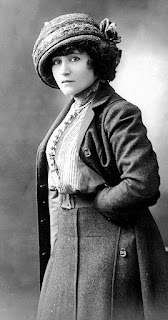
Born in the Burgundy village of Saint-Saveur-en-Puisaye to a war hero father and his wife, the family was orginally prosperous but suffered finanical reversals. She married in 1893 to Henri Gauthier-Villars ("Willy"), a writer and publisher 14 years her senior. Her first 4 books (the "Claudine" titles) were published under his name and copywright. When they separated in 1906 (and later divorced in 1910), she had no income from her own writings. She worked in journalism and on the music hall stage, as well as practicing as an amateur photographer. She also had relationships with several women, including the famous Natalie Barney, as she continued her writing.
In 1912, she married Henri de Jouvenal, and in 1913 had her daughter ('Bel-Gazou"). She published her very popular (and scandalous!) Cheri in 1920, and her writing career took off quickly. She was divorced again in 1924, and in 1925 married Maurice Goudeket, who was her husband for the rest of her life.
The 1920s and '30s were very productive for her work, and she was acclaimed as France's greatest female writer. She was 67 when the Germans occupied France, and she stayed in her Paris apartment on the Palais-Royal despite the arrest of her Jewish husband in 1941 (he was quickly released, and they spent the rest of the war quietly). In 1944, she wrote her most famous work, Gigi. Postwar, she was famous but ill with arthritis, nursed by her husband, and continued to write. (She was nominated for the Nobel Prize in literature in 1948). When she died on August 3, 1954, she was the first French woman of letters to receive a state funeral, and was buried in Pere Lachaise.
A couple of sources for her fascinating life:
Judith Thompson, Secrets of the Flesh: A Life of Colette (1999)
Annie Goetzinger, The Provocative Colette (2018)
Barnes & Noble is having a pre-prder sale through the 28th! You can use it for "Winning Back His Duchess," if you feel so inclined 😀


O my Luve is like a red, red rose
That’s newly sprung in June;
O my Luve is like the melody
That’s sweetly played in tune.
So fair art thou, my bonnie lass,
So deep in luve am I;
And I will luve thee still, my dear,
Till a’ the seas gang dry.
Till a’ the seas gang dry, my dear,
And the rocks melt wi’ the sun;
I will love thee still, my dear,
While the sands o’ life shall run.
And fare thee weel, my only luve!
And fare thee weel awhile!
And I will come again, my luve,Though it were ten thousand mile.
Orange Pineapple Margarita
2 oz Tequila1 oz Triple Sec1 oz Fresh Orange Juice2 oz Pineapple Juice1/2 oz Fresh LimeCombine all in a shaker with ice. Mix it up and pour into a rimmed glass...

When I started writing Violet’s story, I was so excited to combine two of my old passionate interests into one book—the history of the British royal family, and nineteenth century Russia! I also got to bring in another interest of mine, which might not really seem to fit into the 1870s—1930s screwball comedies! I love it when strait-laced Cary Grant begins to enjoy life thanks to Katherine Hepburn or Irene Dunn, learning to have fun at last. I also got to learn something quite new to me, Victorian photography.
Much like Prince Charles and Lady Diana in the 1980s, Prince Alfred (second son of Queen Victoria, a career naval officer) and Grand Duchess Marie, only daughter of Tsar Alexander II (who had many, many sons!) was the wedding of the year. They met in 1868, but neither family approved of the match, and they didn’t marry until January1874. It was a very lavish wedding at the Winter Palace, an Orthodox ceremony followed by an Anglican blessing, then a banquet for 700 and ball for 3000 until the early hours of the morning. It was the sensation of the newspapers, with a Who Is Who guest list of people like the Prince and Princess of Wales, Princess Royal Vicky and her husband, Prince Arthur, and the elderly Ernst, Duke of Saxe-Coburg (who had no legitimate children so Alfred eventually was his heir). (For more wedding details, I love the sadly now defunct blog, Order of Sartorial Splendor, whose archives are a gold mine!).

(One quick note on the photographic exhibit Violet visits—it’s based on a famous display in 1864, a “Bazaaar for the benefit of female artists” at the Horticultural Gardens at Chiswick. The photographers Julia Cameron, Clementina Hawarden, Lewis Carroll, and Oscar Rejlander are of course real figures, as are the royal family.)
If you’re curious about the time period, I loved these sources for further study! And visit me at ammandamccabe.com for more info!
Photography
Todd Gustavson, Camera: A History of Photography (2009)
Alma Davenport, The History of Photography: An Overview (1991)
Bruce Bernard, Photo Discovery: Masterworks of Photography 1840-1940 (1980)
Victoria Olson, From Life: Julia Margaret Cameron (2003)
Victorian Giants: The Birth of Photography (exhibition catalog)
BEC Howarth-Loomes, Victorian Photography (1974)
Royalty
Daphne Bennett, Queen Victoria’s Children (1980)
John Van Der Kiste, Alfred: Queen Victoria’s Second Son (2013)
Julia Baird, Victoria the Queen (2016)
Adrian Tinniswood, Behind the Throne: A Domestic History of the British Royal Household (2018)
Daphne Bernard, Vicky: Princess Royal of England and German Empress (1971)
Jane Ridley, The Heir Apparent: A Life of Edward VII (2013)
Marie, Queen of Romania, The Story of My Life (reprint 2019)
Richard Hough, Edward and Alexandra
Russia
Stefano Papi, Jewels of the Romanovs (2010)
Mathilde Kschenssinskaya, Dancing in Petersburg (1961)
The Last Grand Duchess: Memoirs of Grand Duchess Olga (1964)
Russia: Art, Royalty, and the Romanovs
Susan McCaffray, The Winter Palace (2018)
A little late in the weekend, but better late than never!!! I hope you all had a lovely holiday season. I've finally put the decorations away, and am digging out to try and concentrate on writing the new book. In the meantime, here are a few fun reads I've come across lately...
Legendary Nights With The Bright Young Things
The Duchess of Cambridge Turns 40!
Everyone Is Dressing Like A Bookstore Regular
The Great Sidney Poitier Passed Away
The Last Letter Of Mary Queen Of Scots
Walt Disney Borrowed From 18th Century France For Princess Culture
When Montmartre Was Harlem On The Seine
An Intimate Glimpse Of Frida Kahlo's Blue House
Santa Fe's La Fonda On The Plaza Turns 100 (I used this gorgeous place a lot in my Santa Fe 1920s Mysteries!)

Edith Piaf - La vie en rose (Officiel) [Live Version] - Bing video

In 1564, Elizabeth I was 31 years old and had been on the throne for six years. They were very challenging years; her sister Queen Mary had left England in financial and religious turmoil, and Elizabeth had to fix all of this as well as fend off suitors and increasing pressure from her ministers to marry. In October 1562 she survived a bout of smallpox; in 1563, plague swept the country. By Christmas of 1564, the Queen and her Court were ready to party, but it proved to be the coldest winter in living history. Even the Thames froze through, but Elizabeth wasn’t going to keep this from spoiling her fun! In fact, she used the terrible weather to make the holiday even more special.
Elizabethan Christmases were literally “the twelve days of Christmas,” culminating in a huge feast on Twelfth Night (January 6). Each day had its own activity—the bringing in of the Yule log on Christmas day; a fox hunt on St. Stephen’s Day, December 26 (where the Queen would ride down the Strand, through Cheapside, and over London Bridge to Greenwich Great Park, among the cheers of the crowds gathered to see her). There were plays, dancing, and feasting every night. When the Thames was deemed solid on December 21, a Frost Fair was set up on the ice, with booths selling food, warm cider, and ribbons, as well as sledding, skating, and games. (This works very well for my Swedish hero, Anton, who attempts to teach the heroine Rosamund to skate!)
But it wasn’t all feasting and games. The Queen kept Christmas at Whitehall that year, and as usual there was a tremendous amount of political skullduggery going on in the palace’s vast corridors. Her Privy Council and chief advisor Lord Burghley still pressed her to marry, and there was no shortage of eager suitors. King Eric XIV of Sweden (who in 1568 would be declared insane and overthrown by his brother) was fighting two wars and needed an influential wife. Elizabeth turned him down when she first came to the throne in 1558, but he tries again. (Anton Gustavson comes to London as part of the diplomatic party from Stockholm. But he has his own agenda in England—and Rosamund Ramsay is a complication he doesn’t need!). The Austrians and French, too, want to try their luck in the marital stakes.
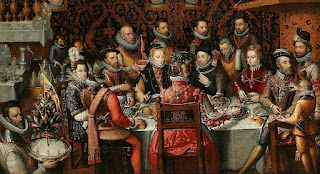
My heroine, Lady Rosamund, lands right in the middle of all this Christmas intrigue! Her parents disapprove of her romantic flirtation with their neighbors’ unreliable son, and hope by sending her to Court as one of the Queen’s Maids of Honor she will be distracted (and find a better match!). There were many levels of service to the Queen for high-born ladies—there were ladies of the Bedchamber (the highest honor), the Privy Chamber, and the Presence Chamber, as well as the six Maids. These were unmarried young ladies, paid 40 pounds a year to walk with the Queen, sit with her, go with her to church, etc. And the Queen did not like for them to have romances. The history of the Elizabethan Court is littered with tales of young women who landed in the Tower for getting caught in dalliances—as Rosamund and Anton know well…
Here are a few great sources I found when researching The Winter Queen:
 Liza Picard, Elizabeth’s London
Janet Arnold, Queen Elizabeth’s Wardrobe Unlock’d and Patterns of Fashion, 1560-1620
Anne Somerset, Elizabeth I and Ladies in Waiting: From the Tudors to the Present Day
Dunlop, The Palaces and Progresses of Elizabeth I
Alan Haynes, Sex in Elizabethan England
Alison Sim, Food and Feast in Tudor England
Maria Hubert, Christmas in Shakespeare’s England
Simon Thurley, Whitehall Palace: The Official Illustrated History
Josephine Ross, The Men Who Would Be King
Figgy Pudding: Chop ½ pound dried figs and mix with ¼ cup bread crumbs. Lightly brown 1 cup of “autumn gathered” walnuts and mix with 1 cup brown sugar, 3 tbsp melted butter, 4 beaten eggs, and spices (1/2 tsp cinnamon, ¼ tsp nutmeg). Bake for at least an hour and serve with cream or “hardsauce” (made from Madeira or malmsey!)
Twelfth Night Cake: In a bowl, combine ½ cup orange juice with 1 cup golden and 1 cup dark raisins and let stand. Cream 1 cup butter, 1 cup sugar, 2 cups wheat flour, and 4 fresh eggs. Add the undrained raisin mixture and a pinch of cinnamon. Stir together and bake until a knife inserted in center comes out clean. Melt 3 tbsp of honey to glaze the cake, decorating with candied cherries. They often add a pea and a bean, so the finder of the bean is king for the evening and the finder of the pea is queen!
Roast Peacock: Take a peacock, break its neck and drain it. Carefully skin it, keeping the skin and feathers together with the head still attached by the skin of the neck. Roast only the bird, with the legs tucked under. When it is roasted enough, take it out and let it cool. Sprinkle cumin on the inside of the skin, then wind it with the feathers and tail around the body. Serve with the tail feathers upright, its neck propped up from within and a lighted taper in the beak. If it is a royal dish, cover the beak with fine gold leaf. Serve with ginger sauce (and lots of pomp and ceremony)
Maids of Honor: Make pastry dough enough for a double-crust pie. Preheat brick over by burning wood or coals inside, then rake them out. Roll out pastry and cut in rounds, then fit in small tartlet tins. Prick pastry with fork tines. Bring to near boil ½ pint cow’s milk with 4 level tbsp white breadcrumbs. Remove from heat and leave for a few minutes. Into that mixture beat 8 tsps butter, cut in cubes, 2 tbsp sugar, grated rind of one lemon, and ¾ cup blanched almonds. Be sure the mixture is not lumpy. Beat in 3 eggs. Half fill the pastry shells and bake for 15 minutes or until mixture is golden brown.

Finding the Musical Spirit of Notre Dame
How To Make Your Home Feel Like a Wes Anderson Set
What Was So Special About Great Garbo
Celebrating the Lost Work of Shakespeare's Female Editors
How to Celebrate Christmas Like Charles Dickens
The Queen's Devoted Mistress of the Robes Has Died at 101
The Hidden Agency of Women in Medieval Poetry
A story of the salvation of a Tudor Great Chamber
Re-reading Mrs. Dalloway During a Pandemic
And the royals had a festive carol service at Westminster Abbey, and everyone wore great coats!
And your Holiday Cocktail of the Week:
Frozen Cranberry Daiquiri
The Spanish Armada (Grande y Felicisima Armada, “great and most fortunate navy”) was one of the most dramatic episodes of the reign of Elizabeth I, and one of her defining moments. If it had succeeded, the future of England would have been very different indeed, but luckily, weather, Spanish underpreparedness, and the skill of the English navy were on the queen's side. The mission to overthrow Elizabeth, re-establish Catholicism in England, and stop English interference in the Spanish Low Countries, was thwarted.
King Philip began preparing his invasion force as early as 1584, with big plans for his fleet to meet up with the Duke of Parma in the Low Countries, ferry his armies to England, and invade. His first choice as commander was the experienced Marquis of Santa Cruz, but when Santa Cruz died Philip ordered the Duke of Medina Sedonia to take command of the fleet. The Duke was an experienced warrior - on land. He had no naval background, and no interest in leading the Armada, as the invasion fleet came to be called. He begged to be dismissed, but Philip ignored the request, as well as many other good pieces of advice about adequate supplies and modernizing his ships.
After many delays, the Armada set sail from Lisbon in April 1588. The fleet numbered over 130 ships, making it by far the greatest naval fleet of its age. According to Spanish records, 30,493 men sailed with the Armada, the vast majority of them soldiers. A closer look, however, reveals that this "Invincible Armada" was not quite so well armed as it might seem. Many of the Spanish vessels were converted merchant ships, better suited to carrying cargo than engaging in warfare at sea. They were broad and heavy, and could not maneuver quickly under sail. The English navy, recently modernized under the watch of Drake and Hawkins, was made up of sleek, fast ships, pared down and maneuverable. Naval tactics were evolving; it was still common for ships to come alongside each other and allow fighting men to engage in hand to hand combat. Advances in artillery were only beginning to allow for more complex strategies and confrontations at sea. At this stage the English were far more adept at artillery and naval tactics than the Spanish, who were regarded as the best soldiers in Europe.
The Spanish plans called for the fleet to sail up the English Channel and rendezvous off Dover with the Duke of Parma, who headed the Spanish forces in the Netherlands. This in itself presented huge problems. Communications were slow, and the logistical problems of a rendezvous at sea were immense. Perhaps worst of all the problems faced by the Armada was Philip himself. The king insisted on controlling the details of the Armada's mission. He issued a steady stream of commands from his palace of the Escorial, yet he seldom met with his commanders, and never allowed his experienced military leaders to evolve their own tactics. He did not listen to advice, which was a shame, for Philip had little military training and a poor grasp of naval matters. He firmly believed that God guided him, and that therefore his mission would succeed.
A series of signal beacons atop hills along the English and Welsh coasts were manned. When the Spanish ships were at last sighted of The Lizard on July 19, 1588, the beacons were lit, speeding the news throughout the realm. The English ships slipped out of their harbor at Plymouth and, under cover of darkness, managed to get behind the Spanish fleet. The Spanish sailed up the Channel in a crescent formation, with the troop transports in the center. When the Spanish finally reached Calais, they were met by a collection of English vessels under the command of Howard. Each fleet numbered about 60 warships, but the advantage of artillery and maneuverability was with the English.
Under cover of darkness the English set fireships adrift, using the tide to carry the blazing vessels into the massed Spanish fleet. Although the Spanish were prepared for this tactic and quickly slipped anchor, there were some losses and inevitable confusion. On Monday, July 29, the two fleets met in battle off Gravelines. The English emerged victorious, although the Spanish losses were not great; only three ships were reported sunk, one captured, and four more ran aground. Nevertheless, the Duke of Medina Sedonia determined that the Armada must return to Spain. The English blocked the Channel, so the only route open was north around the tip of Scotland, and down the coast of Ireland. Storms scattered the Spanish ships, resulting in heavy losses. By the time the tattered Armada regained Spain, it had lost half its ships and three-quarters of its men, leaving a fascinating trove of maritime archaeological sites along the Irish coast (and myths of dark-eyed children born to Irish women and rescued Spanish sailors! In reality, most of them met fates far more grim and sad).

If you'd like to read more about this fascinating and tragic event, here are a few sources I liked:
Robert Milne-Tyne, Armada!, 1988
Ken Douglas, The Downfall of the Spanish Armada in Ireland, 2009
Neil Hanson, The Confident Hope of a Miracle: The True History of the Spanish Armada, 2003
Laurence Flanagan, Ireland's Armada Legacy, 1988
James Hardiman, The History of the Town and Country of Galway, 1820
Colin Martin, Shipwrecks of the Spanish Armada, 2001
When "getting back to normal" can feel terrifying
A lost Italian village emerges after 70 years underwater
Hidden inscriptions discovered in Anne Bolyen's Prayer Book
Princess Beatrice is expecting her first baby! Congratulations
Brooches are making a style comeback, yay!


