Saturday, May 07, 2011

Heroine of the Weekend

And now back to our Heroines! This weekend we're still on the royal trend, with a look at Queen Mary of Modena, who died on May 7 in 1718.

She was born Maria Beatrice Anna Margherita Isabella d'Este on October 5, 1658, the eldest child of Alfonso IV, Duke of Modena in Italy. Her father died when she was 4 and her mother Duchess Laura became regent for her only brother Francesco. Mary was said to be well-educated, speaking French, Italian, English, and Latin, as well as being tall and very pretty. It was thought for a time she would marry Charles II of Spain, but in the end was wed to James, Duke of York, by proxy on September 30, 1673.

James wasn't the ideal husband for a pretty young woman. He was 25 years older than Mary, a widower with two near-grown, tempermental daughters, Mary and Anne, and a known womanizer. Her marriage was also extremely unpopular in Protestant England. She was called "the Pope's Daughter" in the tabloids of the day, and the Protestant Parliament threatened to annull the marriage until Charles II stepped in on his brother's behalf and suspended Parliament until January 1674. The marriage stood, and eventually Mary found a way to get along with her husband. Their first child, Catherine Laura, was born in January 1675, but sadly proved to be the first in a long line of children to die in infancy.

After the duchess's Catholif secretary was embroiled in the trumped-up "Popish Plot" to kill the king in 1678, the Yorks were exiled to Brussels and later to Edinburgh. Separated from her only living child Princess Isabella (who died in 1681), faced with her husband's affair with Catherine Sedley, she grew depressed. But by May 1682 they were back at Court. She became queen on the death of Charles II in February 1685. Their lavish joint coronation (the first since Henry VIII and Catherine of Aragon) cost 119,000 pounds, and Mary's crown can still be seen at the Tower.

She was still in bad health, at times so much so that there was much speculation in Europe as to who her husband might wed next. But she rallied, and after a visit to Bath in 1687 she was pregnant again. This time the baby was a healthy boy, Prince James. A rumor spread that the real royal baby died and a replacement was smuggled in via warming pan, a ridiculous tale that was still much believed (and spread by Princess Anne). The furor over the royal couple's Catholicism and the prospect of a Catholic heir led to the Glorious Revolution, and Princess Mary and her husband William of Orange taking over the English throne while James and Mary fled to France.

Mary was called the "Queen Over the Water" by their Jacobite supporters, and settled into life in Louis XIV's France. She was very popular at Versailles. Madame de Sevigne proclaimed her "distinguished bearing and quick wit." (James meanwhile was excluded from most of the fun, as he was considered quite dull!). James suffered his final defeat at the Battle of the Boyne in 1690 (Mary had helped finance the campaign by selling her jewels). Their last child, Princess Louise Mary, was born in 1692. The couple went on living in France with their children, though despite a generous income from Louis they were often broke (Mary had a habit of supporting Jacobite exiles).


James suffered a stroke in March 1701 and died on September 16. Louis XIV then proclaimed young James the King of England (much to King William's ire) and Mary as his regent, a post which ended when her son turned 16. She disliked politics and was stressed and depressed by the turmoil around her. After her son was exiled from France under the terms of the Treaty of Utrecht and her daughte died in 1712, she lived quietly in poverty at the convent at Chaillot until her death in 1718. She was buried among the nuns.

Some sources on her life:
--Martin Haile, Queen Mary of Modena: Her Life and Letters (1905)
--Tim Harris, Revolution: The Great Crisis of the British Monarchy, 1685-1720 (2007)
--Carola Oman, Mary of Modena (1962)
--Maureen Waller, Ungrateful Daughters: The Stuart Princesses Who Stole Their Fathers Crown (2002)

Friday, April 29, 2011

Friday

So you know what I'm watching all day today, of course!


Tuesday, April 26, 2011

Tuesday


I have been such a slacker lately!! No Heroine, no Hottie--sigh. It was a very busy weekend, and now I'm battling a sore throat and writing 2 WIPs on cough medicine. Fun! But I am at the Riskies today, looking at pics of royal brides...

Saturday, April 16, 2011

Heroine of the Weekend

We have a slightly different Heroine post this weekend--a look at the work of Marie Antoinette's favorite artist Elisabeth Vigee-Lebrun, born on April 16, 1755. (For more info on her long and fascinating life, take a look here...)


Tuesday, April 12, 2011

Tuesday


At the Riskies today, looking at Victorian fashion, Jane Eyre, and some other stuff...

Sunday, April 10, 2011

Heroine of the Weekend

Sorry for the (very) belated Heroine post (though it is actually still weekend, I think...)! But our Heroine is quite timely, considering the government hoo-ha of the last week. We'll take a look at Frances Perkins, the first woman appointed to the US Cabinet, who was born April 10, 1882.

Born Fannie Coralie Perkins in Boston, to parents who owned a stationer's business, she grew up extraordinarily well-educated for a woman in turn-of-the-century America, getting a Bachelor's in chemistry and physics at Mount Holyoke and a Master's in political science from Columbia. While working on her degrees she served as a teacher and a volunteer at settlement houses like Hull House, where she gained a first-hand knowledge of the struggles of the working class. She then worked for the New York Consumers League where she rallied for better working conditions and fair labor laws, eventually becoming New York State Industrial Commissioner.

In 1913 she married Paul Wilson, keeping her maiden name. The couple had one daughter, Susanna, but both father and daughter suffered from mental illness.

In 1929 the new governor of New York, Franklin Delano Roosevelt, appointed her to the commissioner post, thus beginning a long and successeful working relationship that would have long-term affects for the country. In 1933, she was made President Roosevelt's Secretary of Labor, a post she would hold until 1945. She championed the New Deal, including the Civil Conservation Corps, the Public Works Administration, laws against child labor, the Fair Labor Standards Act (which enforced minimum work ages and the 40-hour work week), and the Social Security Act among other vital work.

In 1945 President Truman appointed her to the US Civil Services Commission, where she served until she retired in 1952. She then taught and lectured at Cornell University until her death on May 14, 1965. She was buried in Maine, and in 1980 the headquarters of the US Department of Labor in Washington DC was named the Frances Perkins Building.

A couple of great sources on her life:
Kirstin Downey, The Woman Behind the New Deal: The Life of Frances Perkins, FDR's Secretary of Labor and His Moral Conscience (2009)
Naomi Paschoff, Frances Perkins: Champion of the New Deal (1999)

Tuesday, April 05, 2011

Tuesday

It's Tuesday, so I am at the Riskies, talking about inspiration and hot guys. What inspires you??

Monday, April 04, 2011

Hottie Monday

Have a bit of a rushed Monday going on today, but let's enjoy a little Colin Firth to get the week started...

Sunday, April 03, 2011

Squee Now Posted

My Vampire Diaries convention post is now up at Heroes & Heartbreakers! Comment for a chance to win season 1 DVDs (which everyone should own, IMO...)

Conventions Etc

Finally starting to recover from the craziness that was the Vampire Diaries convention!! For more info on my adventures there, check out my post at the Heroes and Heartbreakers blog (coming soon, I will post a link...)


Sunday, March 20, 2011

Heroine of the Weekend

This weekend's Heroine is Matilda Gage, suffragist, Native America rights activist, abolitionist and author, who died on March 18, 1898. She's not as well-known as some of the early suffragists, but was a tireless worker for human rights.

Matilda was born March 24, 1826, the daughter of abolitionist Hezekiah Joslyn, and grew up in a house that was a stop on the Underground Railroad, which established her concern for the rights of others. She lived most of her life in Fayettesville, New York, eventually marrying Henry Gage and having 5 children with him (one of her daughters, Maud, married Wizard of Oz author L. Frank Baum).

Her women's rights career was launched when she spoke at the National Women's Rights Convention at Syracuse, NY in 1852 and joined forces with Elizabeth Cady Stanton and Susan B. Anthony (though she came to be considered much more radical than them!). She went on to serve as president of the National Women's Suffrage Association 1875-77, holding other positions within the organization for 20 years. Eventually she and her supporters split off into the more extreme Women's National Liberal Union in 1890.

She became a Theosophist, who opposed the Christian church and it's opposition to a change in women's traditional roles, strongly supportingt the separation of church and state (a debate still ongoing) and publishing such works as Woman Church and State to lay out her position. She was the owner and editor of the feminist The National Citizen, and was arrested for attempting to vote in 1871. She supported Victoria Woodhull in the 1872 presidential election.

Matilda Gage died in 1898 of a stroke. She was cremated, but a memorial stone in her family plot is carved with her lifelong motto: "There is a word sweeter than Mother, Home, or Heaven. That word is Liberty."

A couple of sources on her fascinating life:
Sally Roesch Wagner, Matilda Joslyn Gage: She Whol Holds The Sky (1998)
Leila R. Brammer, Excluded from Suffrage History: Matilda Joslyn Gage, 19th Century American Feminist (2000)

Thursday, March 17, 2011

Things I Love Thursday


I just realized I haven't done a Things I Love Thursday post in a while! I need to start that again--I think I need some gratitude in my life. But this Thursday I love--St. Patrick's Day!! What's not to love? Guinness, the Chieftains, my favorite green scarf, and all things Irish. (For a brief look at St. Patrick and the history of his day, you can look here...)

And if you happen to be on Twitter, Grand Central Publishing is having a giveaway today, including my two "Daughters of Erin" books, Countess of Scandal and Duchess of Sin! Look for #4EvrStPatty. Erin Go Bragh!

(also, I'm at H&H today talking about Irish romance...)

Saturday, March 12, 2011

Heroine of the Weekend

Our heroine this weekend is Anne Hyde, Duchess of York, who was born on this day in 1637, and until Lady Diana Spencer was the only non-royal royal bride. (See how it flows into yesterday's post about the new Kate Middleton doll???)

Anne was born at Cranbourne Lodge, Windsor, but spent most of her youth in exile with the court of Charles II--her father, Sir Edward Hyde (later made an earl) was one of the king's most trusted advisers, and Anne served as a lady-in-waiting to Charles's sister Mary, Princess of Orange. On a visit to Paris with the princess, she met James, Duke of York, and the two embarked on an affair that ended in pregnancy and a secret marriage in the Netherlands in 1659. (They were "officially" remarried the next year in London, following the Restoration).

Anne was not considered beautiful, but she more than made up for it with great intelligence and energy, and a famous virtue that made her not very popular with Charles's court. She was a patron of the arts, and involved in politics and current events in a way that never interested her husband. Though the marriage was not happy (James was flagrantly unfaithful) they worked well together. The French ambassador declared Anne had "courage, cleverness, and energy almost worthy of a king's blood," while Pepys wrote "the duke, in all things but his amours, was led by the nose by his wife."

The royal couple had several children, but only two, the future queens Mary and Anne, survived. Anne Hyde died young, probably of breast cancer, soon after having her 8th child on April10, 1671, and was laid to rest at Westminster Abbey. Like her husband, she converted to Catholicism late in her life, an action that would have dire consequences when he later became king...

I wasn't able to find a biography only of her, but here are a few sources on her life:
Antonia Fraser, King Charles II
Barbara Softly, The Queens of England
The Diary of Samuel Pepys

Thursday, March 10, 2011

Kate Middleton Doll


I love royal wedding memorabilia as much as the next crazy Anglophile, but I am just not sure I would want this tiny Kate Middleton standing on the shelf staring at me all the time.... (though I confess I do have a Princess Di bride doll, my very best childhood Christmas present EVER!)

Saturday, March 05, 2011

Heroine of the Weekend

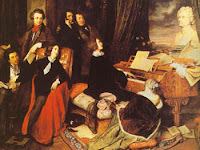
Happy weekend, everyone! Our Heroine this week (now that I have my computer woes somewhat straightened out) is French author Marie d'Agoult (who wrote under the name Daniel Stern, and is perhaps best known today for leaving her husband to run off with Franz Liszt!). She died on this day in 1876.

She was born Marie Catherine Sophie de Flavigny on December 31, 1805, to a Frenchman in exile in Germany and a wealthy German banker's daughter. After spending her childhood in Frankfurt, she was sent to be educated in a French convent after the royal family was restored to the throne, and married the comte d'Agoult in 1827. The couple had 3 daughters, but were eventually divorced in 1835 after she eloped with Liszt. Marie escaped her unhappy marriage by becoming a leading artistic hostess in Paris (attendees at her salon included Hugo, Chopin, and Rossini, among many others, and they remained her friends after she was ostracized by high society).

The notorious couple lived together from 1835 to 1839 and broke up for good in 1844, but they spent their time having children (2 daughters, including Cosima who married Richard Wagner, and one son who died young of tuberculosis) and traveling on Liszt's performance tours. Marie also became involved in writing for the liberal press of the day and starting a career in fiction. Her most sensational work was Nelida, considered to be a fictionalized memoir of her affair with Liszt, but her Essai sur la liberte (1847) was very well-received and gave her a place among such feminist philosophers as Mary Wollstonecraft and Madame de Stael.

Her Lettres Republicanes, written during the 1848 uprising, was a sensation, and she stayed involved in politics during the rest of her life. Though she is overshadowed now by her contemporary George Sand, her contributions to progressive thought, feminism, and literature shoudl not be overlooked.

She died in 1876 and was buried at Pere Lachaise cemetery.

For more information on her very eventful life, look for Phyllis Stock-Morton's The Life of Marie d'Agoult, alias Daniel Stern (2000)

Sunday, February 27, 2011

Shy Duchess launch!


Thanks to some ongoing computer issues here, no Heroine of the Weekend this week, but I am at the Riskies launching my new book The Shy Duchess (and giving away a copy!). Come visit me there....

Wednesday, February 23, 2011

Happy Birthday Handel!

Handel (one of my favorite composers!) was born on February 23, 1685...

Tuesday, February 22, 2011

National Margarita Day


Happy National Margarita Day, everyone! (You gotta love a whole day just for margaritas...)

Monday, February 21, 2011

Hottie Monday, Oscars Edtion

I am finally digging out from under the weekend's computer crisis, yay! And in honor of this weekend's Oscars ceremony, our Hottie Monday is a few nominees. Enjoy! (And who are you cheering for to win?)


Friday, February 18, 2011

Hello Kitty Mania!


How did I miss that Sephora had a new Hello Kitty line before??? Anyway, I just made up for it by ordering way too much stuff. Happy Friday to me!