
Our last November Elizabethan Heroine is Emilia Lanier (or Lanyer), poet and musician. She was born into the musical Bassano family, who served as entertainers at Court. Details of her early life are a bit hard to come by, as very little is known about her aside from church, Court, and legal records and entries of astrologer Simon Forman's infamous diary (she visited him for readings numerous times in 1597).
Emilia was baptized at the church of St. Botolph, Bishopsgate, on January 27, 1569, the daughter of Baptiste Bassano, a Venice-born musician to Queen Elizabeth, and Margaret Johnson, who was possibly the aunt of Court composer Robert Johnson. She also had a sister, Angela, and two brothers who died before reaching adulthood. Her father died when she was 7, leaving Emilia a dowry of 100 pounds.

Forman's records indicate that she then went to live with Susan Bertie, Countess of Kent, perhaps to be fostered by her though the reason is unknown. In this household she was given a fine education, including Latin. Emilia then went to live in the household of Margaret Clifford, Countess of Cumberland, and her daughter Lady Anne Clifford. Her mother died when she was 18, and not long after Emilia became the mistress of the Queen's cousin Henry Carey, Baron Hunsdon.

At this time Lord Hunsdon was the Queen's Lord Chamberlain and a well-known patron of the arts and the theater (he was a supporter of Shakespeare's Lord Chamberlain's Men). He was also 45 years older than Emilia, but she didn't seem to mind. Forman wrote "(She) hath bin married four years. The old Lord Chamberlaun kept her longue. She was maintained in great pomp...she hath 40 a year and was welthy to him that married her in monie and Jewells." In 1592, when she was 23, she became pregnant and was paid off by Hunsdon with a large sum of money. She then married her cousin Alfonso Lanier, another Queen's musician, on October 18, 1592 at St. Botolph's, Aldgate. But it seems this marriage was unhappy, though they were married until his death in 1613. She gave birth to her son Henry in 1593, and a daughter, Odillya, in 1598, who died at 10 months old. Her son married a woman named Joyce Mansfield in 1623 and had 2 children of his own, Mary and Henry. (Court records indicate Emilia was looking after these children when her son died in 1633).
In 1611 she published her volume of poetry,
Salve Deus Rex Judaeorum when she was 42. She was one of the first women in England to declare herself a poet, and her readers considered her work quite radical in subject and unusual stylistically. This book centers on the title poem, a work of over 200 stanzas which tells the story of Christ's passion satirically and from the viewpoint of the women around Him. The main poem is prefaced by 10 shorter works dedicated to aristocratic women, beginning with the Queen. After the central poem is "Dedication of Cookham," dedicated to the Clifford women. It's one of the earliest "feminist" works.
After her husband's death, she supported herself by running a school, but little else is known of her life between 1619 and 1635. She had rent disputes with her landlord, and sued her husband's brother for money owed her from his estate (the courts ruled in her favor, but he would not pay her immediately, so she brought suit again--twice). She died at the age of 76 and was buried at Clerkenwell.
One enduring legend of Emilia Lanier is that she could have been Shakespeare's "Dark Lady," which was first proposed by A.L. Rowse. This can never be known for certain, of course, but it's as plausible a theory as any other!
Some good sources are:
David Lasocki and Roger Prior,
The Bassanos: Venetian Musicans and Instrument Workers in England 1531-1665The Diary of Simon Forman (hilariously bawdy reading!)
The Poems of Emilia LanyerStephanie Hopkins Hughes, "New Light on the Dark Lady" (
Shakespeare Oxford Newsletter, September 22, 2000)
Susanne Woods,
Lanyer: A Renaissance Woman PoetMartin Green, "Emilia Lanier IS The Dark Lady" (
English Studies, Vol. 87 No. 5, October 2006)


 Our last November Elizabethan Heroine is Emilia Lanier (or Lanyer), poet and musician. She was born into the musical Bassano family, who served as entertainers at Court. Details of her early life are a bit hard to come by, as very little is known about her aside from church, Court, and legal records and entries of astrologer Simon Forman's infamous diary (she visited him for readings numerous times in 1597).
 Forman's records indicate that she then went to live with Susan Bertie, Countess of Kent, perhaps to be fostered by her though the reason is unknown. In this household she was given a fine education, including Latin. Emilia then went to live in the household of Margaret Clifford, Countess of Cumberland, and her daughter Lady Anne Clifford. Her mother died when she was 18, and not long after Emilia became the mistress of the Queen's cousin Henry Carey, Baron Hunsdon.
 At this time Lord Hunsdon was the Queen's Lord Chamberlain and a well-known patron of the arts and the theater (he was a supporter of Shakespeare's Lord Chamberlain's Men). He was also 45 years older than Emilia, but she didn't seem to mind. Forman wrote "(She) hath bin married four years. The old Lord Chamberlaun kept her longue. She was maintained in great pomp...she hath 40 a year and was welthy to him that married her in monie and Jewells." In 1592, when she was 23, she became pregnant and was paid off by Hunsdon with a large sum of money. She then married her cousin Alfonso Lanier, another Queen's musician, on October 18, 1592 at St. Botolph's, Aldgate. But it seems this marriage was unhappy, though they were married until his death in 1613. She gave birth to her son Henry in 1593, and a daughter, Odillya, in 1598, who died at 10 months old. Her son married a woman named Joyce Mansfield in 1623 and had 2 children of his own, Mary and Henry. (Court records indicate Emilia was looking after these children when her son died in 1633).


 We continue our November Of Elizabethan Women this week with Mary Sidney Herbert, Countess of Pembroke! Mary was one of the first English women to make a reputation for herself in literary works and patronage, and was considered second only to the Queen as a patron and intellectual of the period.
 After her brother's death, she took on the task of completing and editing his "Arcadia," which was published under the title The Countess of Pembroke's Arcadia, one of the most widely red books of the time. She also finished his translation of the Psalms, which came out as "The Sidneian Psalms," and translated Petrarch's Triumph of Death, along with setting up a chemistry lab at Wilton.
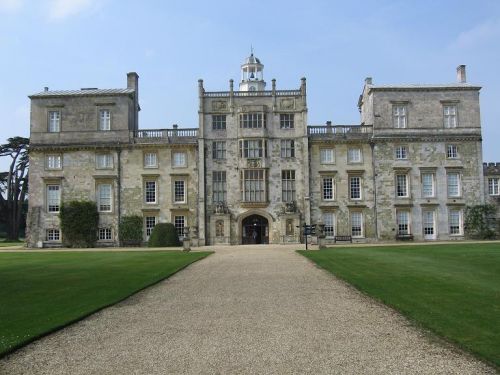 When her husband died in 1600, she took on the management of Wilton for her son William, who followed her example as a literary patron (most famously to Shakespeare). James I visited them there in 1603 and witnessed the premier of Shakespeare's As You Like It. After this blow-out party, she moved to London and took up residence at Crosby Hall (which still stands in Chelsea) and maybe secretly married her doctor, Sir Matthew Lister. She sometimes traveled to Spa to "take the waters" and socialize, and hired Italian architects to build a new country mansion in Bedfordshire, Houghton Hall (now in ruins).
 We continue our Month of Elizabethan Heroines with Lettice Knollys's daughter Penelope Rich! (I would love to write a historical novel about her someday...)
 Her connection to Sidney wasn't ended by the marriage. She is thought to have been the inspiration for his sonnet sequence Astrophil and Stella (there are many puns on her name, and allusions people in the "in crowd" would have understood). Sidney was killed at the Battle of Zutphen in 1586, and became a great English hero of the age. Penelope's brother, the Earl of Essex, then married Sidney's widow Frances (daughter of spymaster Francis Walsingham), and Penelope was much at Court during the time of her brother's time as Queen's favorite. (Poet Richard Barnfield dedicated his book The Affectionate Shepherd to her in 1594, as well as sonnets addressed to her by John Davies and Henry Constable. Hilliard painted her portrait twice; Charles Tessier dedicated his book of part-songs in French and Italian to her, and John Dowland composed "My Lady Rich's Galliard.")
 I also like Emily Van Ever's CD, My Lady Rich, with period music inspired by Penelope!


