Monday, May 28, 2012

Hottie Monday


 What better way to celebrate a holiday weekend than the return of Hottie Monday??  This week's Hottie--Johnny Flynn, English indie musician and actor (he is revisiting his award-winning Viola in Mark Rylance's all-male Twelfth Night, which I wish I could see...)


Sunday, April 15, 2012

Winner!

Thanks to the scary-stormy weekend here in my neck of the woods, I am waaay behin in choosing a winner for my "Rogue" drawing! The winner is....Rosa Alday. Congrats and I hope you enjoy the book...

Thursday, April 05, 2012

Contest!


I have been a BAD blogger! But I am going to start posting here regularly again, and I also received a big box of copies of my May release, The Taming of the Rogue. So to celebrate--contest! Just send me an email to amccabe7551 AT yahoo.com and tell me what you love about the Elizabethan period (or about this gorgeous cover!). I will run the contest over the weekend and have a winner by next Tuesday...
(You can also read more about this book on my website...)

Sunday, January 15, 2012

Heroine of the Weekend

Since today is my birthday, it seemed like a good time to get organized and start doing some blog posts again!! I'm going to start by adding in some new Heroines, since I have missed them. Today's Heroine is Bertha Morisot, born on January 14, 1841.

Morisot was born in Bourges, to a well-to-do and respectable family who nevertheless encouraged their daughters Berthe and Edma in their pursuit of art. (Edma married young and gave up painting, while Berthe was more ambitious). Berthe first studied with Barbizon School artist Camilly Corot, who encouraged her interest in plein-air landscape painting, and later with Edouard Manet, who became one of her greatest friends and colleagues and who used her as his model many times (there are rumors of romance, but no proof has come to light...)

Her first appearance in the prestigious Salon was in 1864, with 2 landscapes. She continued to show at the Salon, to mostly positive reactions, until she joined up with the rebellious Inpressionists in 1873. Her light, free style fit well with their aesthetic, though like the other female Impressionist Mary Cassat she mostly painted images of her own milieu of intimate domestic life, women in their homes, and landscapes.

In 1874 she married Edouard Manet's brother Eugene and had one daughter, Julie. She died of pneumonia on March 2, 1895 and was buried in the Cimetiere de Passy. Her paintings can still be seen in every major museum in the world and are highly sought-after in art auctions...

Some sources on her life:

Anne Higonnet, Berthe Morisot (1995)
Julie Manet, Growing Up With the Impressionists: The Diary of Julie Manet (1987)

Wednesday, October 26, 2011

Hiatus And New Book

Am on a short hiatus here while I finish some deadlines! But in the meantime check out my new November "Undone!" short story--just in time for the holidays

Saturday, September 10, 2011

Heroine of the Weekend


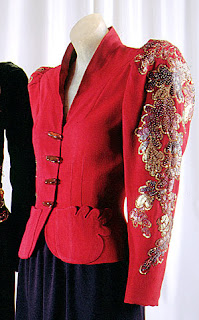
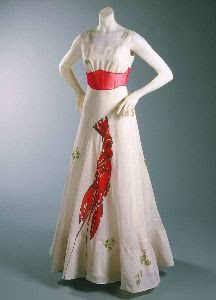
I am off on vacation this weekend, but have to celebrate this week's Heroine--fashion designer Else Schiaparelli, who I love! She was born on this day in either 1890 or 1896 (I found conflicting reports...) Read about her life here and enjoy your weekend!


Sunday, September 04, 2011

Heroine of the Weekend


It's a holiday weekend, and I am supposed to be making appetizers for a cookout tonight but have spent too long reading this morning, so no time for a proper Heroine post! But I do want to celebrate the birthday (September 2, 1838) of Liluokalani, last monarch and only Queen Regnant of Hawaii (I loved touring the royal palace in Honolulu on a trip to Hawaii and found the history fascinating....) Check out more about her life here...and have a great holiday!

Sunday, August 21, 2011

Heroine of the Weekend

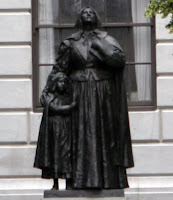
So it's been a while since we've had a Heroine, isn't it? I have been a blog slacker. But I'm getting back into regular posts now, starting with today's look at Anne Hutchinson, early champion of women's rights and religious freedom, who died on August 20, 1643.

Anne Marbury was born in 1591 in Lincolnshire, England, the daughter of a dissident Puritan clergyman whose family was a follower of John Cotton. In 1634 they went with him to North America and settled in Massachusetts. (Anne had married William Hutchinson in August 1612, and they took their children with them to the New World).

But things didn't continue very well once settled. Anne held a Bible study and discussion group in her home, which grew more and more popular as she was reputed to be a charismatic speaker and brilliant thinker (it was mostly women who attended at first, but she soon attracted men to her group, including Sir Henry Vane, who was later a governor of Massachusetts). The group grew to over 80 members and attracted the attention of the authoritarian church elders of the colony. At a time of strict uniformity, Anne expressed her own interpretations of the Bible, as well as her concerns about the lack of women's rights and racial prejudice toward the Native Americans. She was brought to trial in 1637, accused of being an "antinomian heretic". Despite being pregnant with her 15th child she was forced to stand before the judges and face their grilling for days on end (she miscarried). They declared "You have stepped out of your place, you have rather been a husband than a wife, a preacher than a hearer, and a magistrate than a subject." She was excommunicated and banished from the colony, moving with some of her followers to Portsmouth in Rhode Island.

Anne's husband died in 1642, and she moved to Eastchester Bay, which was then part of Dutch New Netherlands. Unfortunately she was caught in a dispute between the Dutch and local Native American tribes and was killed in a native raid in 1643. (One daughter, Susanna, survived, reputedly because of her red hair).

...you have no power over my body, neither can you do me any harme, for I am in the hands of the eternall Jehovah my Saviour, I am at his appointment, the bounds of my habitation are cast in heaven, no further doe I esteeme of any mortal man than creatures in his hand, I feare none but the great Jehovah, which hath foretold me of these things, and I doe verily beleeve that he will deliver me out of our hands, therefore take heed how you proceed against me; for I know that for this you goe about to doe to me, God will ruine you and your posterity, and this whole state.


Some sources on her life:

Robert E. Krieger, Anne Hutchinson: Troubler of the Puritan Zion (1980)

Eve LaPlante, American Jezebel: The Uncommon Life of Anne Hutchinson (2004)

Selma R. Williams, Divine Rebel: The Life of Anne Marbury Hutchinson (1981)


Saturday, July 30, 2011

Heroine of the Weekend

We haven't had a Heroine in a couple of weeks! So let's take a look at Maria Anna (Nannerl) Mozart, born on July 30, 1751....

Nannerl, the older sister of Wolfgang, was born in Salzburg, and started learning the harpsichord from her father Leopold when she was about 7, along with her brother. The two of them became a sensation on the European musical tour circuit, visiting cities and royal courts. At first Nannerl was the number one star attraction, but as she got older that changed--"from 1768 onwards she was no longer permitted to show her artistic talent on travels with her brother, as she had reached marriageable age." She still played music in private and for friends, and her brother later wrote a few pieces for her. There is some evidence from his letters that she also composed, but none of her works survive. While he went on more tours she stayed home with her parents.

After her father refused to let her marry her first choice (it seems she was not rebellious at all, unlike her brother!) she married an older, well-to-do magistrate named Johann Sonnenburg, who was already twice widowed and had 5 children. She had three of her own, two daughters (one of whom died in infancy) and a son, who was raised by her father for his first two years. When her husband died in 1801 she returned to Salzburg with her children and taught music. She seems to have lived quietly for the rest of her life, though she did connect with her brother's widow and son later on.

Some sources on her life:
A novel by Alison Bauld, Mozart's Sister (2005)
Maynard Solomon, Mozart: A Life (1995)
Jane Glover, Mozart's Women (2005)


Wednesday, July 20, 2011

Wednesday

Here's a little something to help me get over the middle-of-the-week doldrums--my fantasy car (plus Richard Hammond, my secret Brit boyfriend....I watched a lot of Top Gear while I was sick...)

Happy Wednesday everyone!

Sunday, July 17, 2011

Blog Tour


No Heroine this weekend (stay tuned next weekend!) but I am on a blog tour with Paula Quinn and Sue-Ellen Welfonder, so be sure and visit me on these sites to comment and win fun stuff!!


July 18:
www.seducedbyabook.com
www.lovetoreadforfun. com
http://maryinhb.blogspot.com
http://www.thebookgirl.net
http://www.reneesreads.blogspot.com/
http://simplystacie.net
http://brokenteepee.com
http://cuzinlogic.wordpress.com
http://blog.readaholic.info
http://booksandmakeup.blogspot.com
http://blog.readaholic.info
http://justanothernewblog.blogspot.com

July 19

http://shamelessromancereviews.blogspot.com
mybookaddictionandmore.wordpress.com

July 20

http://saveyspender.com
www.sosaloha.blogspot.com
http://bodicerippernovels.wordpress.com
http://ashleysbookshelf.blogspot.com

July 21

http://readingwithstyle.blogspot.com
http://asthepagesturn.blogspot.com


July 22

http://inthehammockblog.blogspot.com
Hangingwithbells.blogspot.com
http://onebookshy.blogspot.com
http://teddyrose.blogspot.com/

July 23
http://marthasbookshelf.blogspot.com/

July 24

http://thefictionenthusiast.blogspot.com
sexywomenread.blogspot.com
http://juniperrbreeeze.blogspot.com/
rexrobotreviews.com
http://thecottagebookshelf.blogspot.com/
http://bookslikebreathing.blogspot.com
Lushbookreviewss.blogspot.com
www.startingfreshnyc.com
http://j-rabbits-corner.blogspot.com
http://www.bittenbyparanormalromance.com/


Sunday, July 10, 2011

Heroine of the Weekend

Hello everyone! I am finally ending my long, illness-based hiatus with a short Heroine post, just to get myself back in the blogging mindset (and to celebrate feeling better!). Our Heroine is novelist Ann Radcliffe, born July 9, 1764, and considered the founder of the Gothic sub-genre thanks to her vivid use of dramatic landscapes and the supernatural (though the supernatural always had a logical explanation in the end). When I first started reading romances, Gothics were some of my favorites. Give me a cover with a girl in a nightgown running along a moonlit cliff and I was there! And I have Radcliffe to thank for those great reading experiences.

The reason this post will be brief is simply that not much is known about her life beyond the bare facts. In 1823, the year she died, the Edinburgh Review said "She never appeared in public, nor mingled in private society, but kept herself apart." She was born Ann Ward in London, the daughter of a haberdasher, and in 1787 married William Radcliffe, the editor of the English Chronicle, and started writing soon after. The couple had no children, but were said to have a happy marriage. She died on February 7, 1823, probably of asthma.

She published 6 novels in all, the best known of which are probably and The Mysteries of Udolpho and The Romance of the Forest. She was an influence on many other writers, including Walter Scott, Poe, the Shelleys, and Austen (who parodied "Udolpho" in Northanger Abbey).

Most of my info today came from the intro to my copy of Udolpho and from British Authors Before 1800: A Biographical Dictionary (1952, ed. Stanley Kunitz & Howard Haycraft)

Sunday, June 12, 2011

Heroine of the Weekend

This weekend's Heroine is photographer Julia Margaret Cameron, born on June 11, 1815! She was pioneer in Victorian photography, and also one of the best sources for historical images of the period we have now...

Cameron was born in Calcutta, to a father who was an official in the British East India Company and a mother who was a beautiful French aristocrat (Julia was considered a bit of an "ugly ducking" with her mother and sisters!). She was educated in France, but then returned to India in 1838 to marry Charles Hay Cameron, who was 20 years her senior. 10 years later they moved to London, where her sister hosted a well-known artistic salon at her home Little Holland House, enabling Julia to meet many luminaries of the day (including Tennyson--she was soon his neighbor on the Isle of Wight).

She came to photography later in life, when her daughter gave her a camera in 1863, but took to the art very quickly. Within just a year she was a member of the Photographic Societies of London and Scotland and photographing her famous friends (such as Darwin, Browning, Tennyson, Millais, and the actress Ellen Terry) as well as her family. Her favored subjects were portraits and allegorical scenes in a Pre-Raphaelite style. She was a meticulous perfectionist who sometimes took hours to get a scene just right. She also registered her works with the copyright office and kept records of them all, which ensured many survived.

In 1875 she and her husband moved to Ceylon, where it was hard for her to find the necessary chemicals for her work. She died there in 1879. She once wrote, "I longed to arrest all the beauty that came before me and at length the longing has been satisfied."

Some sources on her life and work:
Joanne Lukitsh, Julia Margaret Cameron (2001)
Julian Cos and Colin Ford, Julia Margaret Cameron: The Complete Photographs (2003)


Tuesday, May 31, 2011

Tuesday

Over at the Riskies today, talking about deadlines (eep!) and summer movies...

Sunday, May 29, 2011

Housekeeping


So, Lady of Seduction is out this week (eeek! How is it June already?), and I am at two blogs giving away copies and talking about the story right now. SOS Aloha and my own Risky Regencies. Come by and say hi....

Saturday, May 28, 2011

Heroine of the Weekend

Our heroine for this last weekend of May is the youngest Bronte sister, Anne, who died on May 28, 1849! Though she is usually overshadowed by her older sisters Charlotte and Emily, her own work is now gaining in appreciation and she's being seen as a literary talent in her own right...

Anne was born, the youngest child of Patrick Bronte (a poor, Irish-born clergyman) and his wife Maria Branwell (daughter of a prosperous Penzance merchant family) on January 17, 1820 in the Yorkshire village of Thornton. Soon after her father took a post at Haworth Parsonage and moved the family to the house that would be their home for the rest of their lives. Her mother died in September 1821, leaving the children to the care of their father and her sister Elizabeth, who moved in to keep house for the family and never left (it was said she didn't get along with the other childern, but Anne was her "pet" of sorts).

The 4 elder daughters, Maria, Elizabeth, Charlotte, and Emily, were sent to the Cowan Bridge School for Clergymen's Daughters in 1824, which proved to be a terrible decision. It was an abusive, unhealthy place, and Maria and Elizabeth died there of TB while Charlotte and Emily were brought home. Anne spent her childhood being taught at home. The siblings were all voracious readers and blessed with vivid imaginations, and they filled their time writing tales of the imaginary kingdoms of Angria and Gondal. Gondal was Emily and Anne's special preserve--they were so close that Charlotte's friend Ellen Nussey said they were "like twins."

Anne was sent to Roe Head school where Charlotte was a teacher when she was 15, her first time away from home (she went to replace Emily, who always broke down when she was sent away from Haworth). She stayed there for two years, a very diligent student who was commended for her good conduct. But Charlotte grew concerned about Anne's health and had her sent home. In 1839, her health recovered, she took a job as governess at Blake Hall, which was not a great success. The children were unruly and spoiled, and Anne came home after less than a year (she later used this as inspiration for her book Agnes Grey). Afetr her return home she may or may not have fallen in love with her father's new curate William Weightman (who may or may not have noticed her in return). He died in 1842 ending any hint of romance in her life.

Anne then took a position as governess at Thorp Green to the 4 children of the wealthy Robinson family (3 daughters and a son). She had the same problem with unruly charges, but gradually became close to the children (two of the daughters still wrote to her after she left the house, and even visited her in 1848). One of the perks of the job was going on holiday with the family to Scarborough, which Anne loved. She also managed to procure a job for her brother Branwell there, as tutor to the son, but he embarked on a scandalous affair with Mrs. Robinson and was sent home in disgrace, where he sank into alcoholism and illness. Anne herself left Thorp Green in June 1845.

That summer all the Bronte siblings were together again, and the sisters came up with a plan to publish a collection of their poetry, which they paid for themselves. It was not a success, but "Fraser's Magazine" published two of Anne's poems, and a new plan was hatched to write novels (under the more masculine names of Currer, Ellis, and Acton Bell). Charlotte wrote The Professor, Emily Wuthering Heights, and Anne Agnes Grey. Charlotte's book was rejected, but Emily's and Anne's were accepted. It proved to be Charlotte who was published first though--her second novel, Jane Eyre, came out to great success and Emily and Anne's publisher (who had been dragging their feet) finally released their books as well, which sold well. (Agnes Grey was rather overshadowed by the scandal of Wuthering Heights!)

Anne's second book, The Tenant of Wildfell Hall, came out in June 1848 to a scandal of its own, in its honest depiction of alcoholism and sexual depravity, and a heroine who left her husband. It was very shocking (though successeful!) and Anne wrote this in defense of her book:

"When we have to do with vice and vicious characters, I maintain it is better to depict them as they really are than as they would wish to appear. To represent a bad thing in its least offensive light, is doubtless the most agreeable course for a writer of fiction to pursue; but is it the most honest, or the safest? Is it better to reveal the snares and pitfalls of life to the young and thoughtless traveller, or to cover them with branches and flowers? O Reader! if there were less of this delicate concealment of facts–this whispering 'Peace, peace', when there is no peace, there would be less of sin and misery to the young of both sexes who are left to wring their bitter knowledge from experience."

The Bronte family seemed on the verge of a breakthrough, but 1848 was a year of tragedy. Branwell died on September 24, and Emily followed on December 19. By February 1849 Anne herself was very ill. She traveled with Charlotte to Scarborough, in hopes that the sea air and the nearness of doctors would help her, but she died on May 28, a "calm and quiet" death. She was buried at St. Mary's church there at Scarborough.

Some sources on her life:
Juliet Barker, The Brontes
Edward Chitham, A Life of Anne Bronte
Rebecca Fraser, The Brontes
Sunday, May 22, 2011

Heroine of the Weekend

So the weekend is almost over (I am not sure where it went! Probably frittered away dealing with an AC that decided to die right when the temps reached the 90s here...), but we can't let it pass without a Heroine. And I can't believe I've never featured Lady Jane Grey before! She was married on May 21, 1553, so she is our (tragic) Heroine this weekend.

Jane was born sometime in 1536 or '37 (there is some doubt to the exact date) at her family's home at Bradgate Park in Leicestershire. Her parents were Henry Grey, the 1st Duke of Suffolk, and Lady Frances Brandon, the niece of Henry VIII through her mother Mary Brandon. The couple had three daughters, studious Jane, beautiful Catherine, and deformed Mary, all of whom would run afoul of their Tudor cousins.

Jane was very well-educated according to the classical model of the day (it was speculated that her parents were preparing her to one day marry her cousin Prince Edward0. She knew modern languages, as well as Latin, Greek, and Hebrew, and was instructed in the new reformed Protestant religion, which she was quite devoted to. She prefered studying to hunting or dancing, and was from all reports a serious young lady. In 1546 she went to join the household of Catherine Parr, the dowager queen and widow of Henry VIII, where she would be educated in humanist, Protestant thought along with her royal cousins. (Jane was the chief mourner at Catherine's funeral in 1548).

After she left Catherine Parr's care, Jane was married to Guildford Dudley, the son of the Duke of Northumberland (one of the most powerful men in England). It was a lavish triple ceremony--her sister Catherine also married, to the heir of the Earl of Pembroke, and Guildford's sister Catherine married the heri to the Earl of Huntingdon. It was a huge power play for the two fathers Suffolk and Northumberland. The reasons for it all soon became clear.

When Henry VIII died his Act of Succession laid out his plans for the future of the throne. If Edward was to die without an heir, the throne would then pass to Henry's two perviously disowned daughters, Mary and Elizabeth. If they died without issue, it would then go to his sister Mary's descendants (the Greys), bypassing his sister Margaret's Scottish line (inlcuding Margaret's granddaughter Mary Queen of Scots). But Edward, who was very ill by the beginning of 1553, laid out his own "Device"--he excluded his sisters altogether (Mary was a devout Catholic, at odds with her strictly Protestant brother throughout his reign; leaving out Elizabeth is more puzzling). He instead directed the succession through Frances Brandon's line, hopefully to Jane's soon-to-be-produced male children. Edward died on July 6, 1553, and everyone sprang into action.

Four days later the king's will was revealed and Jane was proclaimed Queen to shocked Londoners. Jane went in procession to the security of the Tower to await her coronation. A Genoese in London, Baptista Spinola, watched her walk past and described her as "very short and thin, but prettily-shaped and graceful. She has small features and a well-made nose, the mouth flexible and the lips red."

Northumberland's first task to secure his daughter-in-law's reign (even though she had refused to name Guildford king) was to isolate and secure Mary, who naturally expected to be queen. But she had escaped and was rallying her supporters. He rode out of London with his troops on July 14, and while he was gone the Privy Council changed their tune. They saw the wind was blowing toward support of Mary, and the proclaimed her queen to much rejoicing July 19. Jane's palace turned into a prison at the Tower, and Mary entered London in a triumphant procession on August 3. Northumberland was executed August 22.

Even though Jane and her husband were tried, found guilty of treason, and sentenced to death, they were not executed until February 12, 1554. Guildford was beheaded on Tower Hill, but Jane was given the rare privilege of a private execution at Tower Green. She was only 16 or 17 years old, but she faced her death with rare bravery and calm, with only flahs of panic when she was blindfolded and couldn't find the block. She made a short speech:

Good people, I am come hither to die, and by a law I am condemned to the same. The fact, indeed, against the Queen's highness was unlawful, and the consenting thereunto by me: but touching the procurement and desire thereof by me or on my behalf, I do wash my hands thereof in innocency, before God, and the face of you, good Christian people, this day.

With only a few last words, ""Lord, into thy hands I commend my spirit," she held out her arms and was killed. Over the centuries, her youth and innocence have given rise to many romantic images and legends.

A few sources on her life:

Leandra de Lisle, The Sisters Who Would Be Queen: The Tragedy of Mary, Katherine, and Lady Jane Grey (2008)
Eric Ives, Lady Jane Grey: A Tudor Mystery (2009)
Faith Cook, The Nine Days Queen (2005)
Alison Plowden, Lady Jane Grey: Nine Days Queen (1985)

(And for a more detailed explanation of Edward VI's very complicated Device, you can look here)

Friday, May 20, 2011

Friday


Happy Friday everyone! I am still making my way to The End of the 2 projects due June 1, but in the meantime you can read about my June release at Heroes & Heartbreakers....

Sunday, May 15, 2011

Heroine of the Weekend

Happy weekend everyone! (It is still the weekend, right??) Our Heroine this week is composer/musician Fanny Mendelssohn Hensel, who died on May 14, 1847.

Fanny was born November 14, 1805 in Hamburg, the oldest of 4 children, part of a distinguished Jewish family (her grandfather was philosopher Moses Mendelssohn, and her father Abraham ran a prosperous business). Unlike her equally precocious brother Felix, she was not encouraged to pursue her talent for music and composing (he was given the finest teachers, while Fanny had to learn the best she could herself), but she was passionate about music and as talented as her brother from a very young age. (Her father later wrote to her, "Music will perhaps become his profession, while for you it can and must be only an ornament"--pretty much sums up the attitude of the day). But Felix did help her publish some of her works under her own name.

In 1829, after a long courtship, she married artist Wilhelm Hensel, who was luckily very supportive of his wife' s music. (The couple had one child, Sebastian, the year after their marriage). She took part in her family's famous Sunday afternoon concerts (which she took over hosting after her father's death), where many of her pieces were played and discussed. In 1838 she had her one (known) public performance, of her brother's Piano Concerto No. 1. In all she composed some 466 pieces, mostly for the piano, including a song cycle titled Das Jahr (The Year), an amazing output considering her lack of support and encouragement and the expectation that she would always put her home and family first.

Fanny died of a stroke at the young age of 42, in Berlin in 1847. (Her brother died the following year). Her works have become more widely known and played in just the last few years, thanks to new interest in female composers.

A couple sources on her life:
Francoise Tillard, Fanny Mendelssohn (1996)
Sandra Shictman, Dorothy Indenbaum, Gifted Sister: The Story of Fanny Mendelssohn (2007)


Monday, May 09, 2011

Hottie Monday

So I haven't yet seen the movie Thor (this was a crazy busy weekend, and I usually tend to avoid the really loud summer movies), but obviously I am super-tempted.....


I also read that Tom Hiddleston (who I loved in Cranford and Wallander) plays a villain, another reason to maybe see it.


Anyone seen this movie yet? Any opinions?