Showing posts with label Elizabeth I. Show all posts

Sunday, September 07, 2025

Weekend Links


 I just got a new box of books for my next Harlequin release, How to Court Your Wife!!!  It's the 3rd in the Matchmakers of Bath series, and I love it because the heroine, Sandrine, is a modiste.  You know how I love clothes!!!  Her business is booming--now she just has to deal with her much-too attractive estranged husband.  It's releasing on October 23, but I have a few copies to send out for review.  Let me know if you're interested!


In other book news, Secretary to the Socialite is gaining some lovely reviews!  As it's the "book of my heart," this is making me feel quite chuffed and smiley.  


And, as we hover on the brink of autumn (bring on Halloween and apple spice!) here are a few things to read:

Happy birthday, Elizabeth I!  (September 7, 1533)

And the death of her stepmother Queen Katherine Parr (September 5, 1548)

And this week the Duchess of Kent died, aged 92 (a true lady and talented musician, one of the last of the old-school royals, she led a fascinating and sad life)

The (almost) wildness of Elizabeth Bennet

A new "Age of Innocence" adaptation is on its way!  I love Edith Wharton, and it's been 30 years since the perfection of the Scorsese movie, but this description of being a "modern young version for a new generation" does not sound---reassuring....

The stately settings of "Downton Abbey"  (last movie is out next week, woo-hoo!)


Monday, January 16, 2023

The coronation of Elizabeth I


(A blog post re-run today!  Yesterday, January 15, as well as being This Author's birthday, is the anniversary of Elizabeth I's coronation in 1559!  I had lots of fun researching the event as the backdrop of my mystery Murder at Westminster Abbey...)


Synopsis:  January 1559.  Life at the center of the new royal court is abuzz with ambition and gossip—very different from the quiet countryside, where Kate served Elizabeth during her exile. Making her way among the courtiers who vie for the new queen’s favor, Kate befriends Lady Mary Everley. Mary is very close to Elizabeth. With their red hair and pale skin, they even resemble each other—which makes Mary’s murder all the more chilling.
 
The celebrations go on despite the pall cast over them. But when another redhead is murdered, Kate uncovers a deadly web of motives lurking just beneath the polite court banter, and follows the trail of a killer whose grievance can only be answered with royal blood.

When I started writing Murder at Westminster Abbey, I had lots of fun digging through boxes looking for photos and scrapbooks of my trips to England, and I got to revisit my very first visit to Westminster Abbey! It was a rainy, stormy day, and I had just arrived in London after a long overnight flight. The hotel room wasn’t yet ready, I was jet-lagged and a bit silly with lack of sleep and too much Chardonnay (I am a terrible flier!). So what could be better than a few hours wandering around in the cool darkness of Westminster Abbey, out of the rain?

For a lifelong history geek like me, the Abbey was a magical place. I spent hours at Poet’s Corner, visiting Chaucer and Browning. I stumbled across Anne of Cleves, Margaret Beaufort, and Aphra Behn, and stood atop where Oliver Cromwell once lay, before the Restoration came and he was dug up again. Best of all, I found myself nearly alone for a few precious minutes at the tomb Elizabeth I shares with Mary I.

It was wonderful to revisit my memories of that trip (and re-watch a DVD of William and Kate’s wedding, just for research on cathedral details, of course!). It was also a lot of fun to delve deeply into the events surrounding Elizabeth I’s coronation—I almost feel like I could have been there now, and met all the historical figures who played a part in the glittering events. I loved weaving the real pageantry with my fictional characters and what happened to them on those momentous days in January 1559.
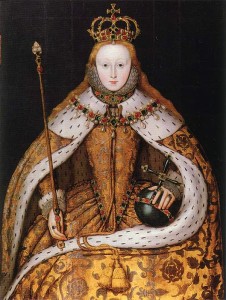
ElizabethCoronationQueen Mary’s funeral was on December 14, 1558, and Elizabeth then moved to Whitehall Palace to celebrate the Christmas season with a series of feasts and dances, organized by her newly appointed Master of the Horse, Robert Dudley. But there was work to be done as well as dancing, a household to organize, counselors to appoint, and a coronation to plan. The city, which had been quiet and somber for the last months of Queen Mary’s sad life, sprang to life. Viewing stands were built, streets graveled, the river cleaned up, and vast quantities of cloth of gold and silver, silks, velvets, and satins were ordered. Seven hundred yards of blue cloth was laid as a carpet from Westminster Palace to the Abbey. Despite the economy of re-making Queen Mary’s royal robes for Elizabeth’s more slender figure, the Exchequer paid out more than 18,000 pounds.

Dr. John Dee, the new queen’s favorite astrologer, laid out a horoscope predicting January 15 as the best date for the coronation. He didn’t predict the fact that the weather would be gray, cold, and icy, but the party went on. On January 12, the queen boarded her barge at Whitehall and processed along the Thames to the Tower, where new monarchs traditionally slept before their coronation. Accompanied by dozens of other barges, musicians, the Mayor and his aldermen, she floated past hundreds of people lining the riverbanks to toss flowers and shout their approval. (The poor victim in my story, Nell, watches this procession before she sadly loses her life. She’d heard from her grandmother about Queen Anne Boleyn’s procession, and wants to see Queen Anne’s daughter go by now…)

On leaving the Tower, Elizabeth processed four miles through London, wearing 23 yards of cloth of gold and silver trimmed with ermine, riding in a white litter lined with gold and drawn by white mules. Trumpeters proceeded her, and her household rode behind, dressed in their finest red velvets and furs to watch five stately pageants that symbolized the new beginning of the reign. I loved having my heroine, Kate Haywood, ride behind the queen, taking it all in.

As for the coronation itself…you will just have to read Murder at Westminster Abbey for a glimpse of it!

Here are a few of the resources I found useful:

–Greville Cook, Queen Elizabeth And Her Court Musicans (Musical Times, 79, 1918)

–AL Rowse, Elizabeth’s Coronation (History Today, III, 1953)

–Lawrence E. Tanner, The History and Treasures of Westminster Abbey, 1953

–Neville Williams, The Coronation of Elizabeth I (Quarterly Review, 597, 1953)

–WI Woodfill, Musicians in English Society from Elizabeth to Charles I (1953)

Sunday, January 01, 2023

Blog Post Redux! The Queen's Christmas Summons

 (a repeat of a blog post I did in 2016 at the Word Wenches! about The Queen's Christmas Summons, one of my favorite books to write)


 I’m so excited to have the chance to talk a bit about the history behind the book for my new release The Queen’s Christmas Summons. This story has been brewing in my mind for a long time, ever since I was a little girl and my grandmother (who was very proud to be Irish, and have the famous “black Irish” looks of dark hair, olive skin, and bright blue eyes) told me she was descended from a shipwrecked Spanish soldier who landed on Ireland’s coast in a storm and married a Galway woman. This story, while fantastic, is almost certainly a family legend, but it made me wonder—what would really happen if two such people met??? That’s how John (an English spy planted with the Armada) and his love Alys came to be. She saves his life on the Irish shore—and they meet up later at the queen’s own court for Christmas.


Invincible_ArmadaThe Spanish Armada (Grande y Felicisima Armada, “great and most fortunate navy”) was one of the most dramatic episodes of the reign of Elizabeth I, and one of her defining moments. If it had succeeded, the future of England would have been very different indeed, but luckily, weather, Spanish underpreparedness, and the skill of the English navy were on the queen’s side. The mission to overthrow Elizabeth, re-establish Catholicism in England, and stop English interference in the Spanish Low Countries, was thwarted.

GentlemanKing Philip began preparing his invasion force as early as 1584, with big plans for his fleet to meet up with the Duke of Parma in the Low Countries, ferry his armies to England, and invade. His first choice as commander was the experienced Marquis of Santa Cruz, but when Santa Cruz died Philip ordered the Duke of Medina Sedonia to take command of the fleet. The Duke was an experienced warrior – on land. He had no naval background, and no interest in leading the Armada, as the invasion fleet came to be called. He begged to be dismissed, but Philip ignored the request, as well as many other good pieces of advice about adequate supplies and modernizing his ships.


Loutherbourg-Spanish_ArmadaAfter many delays, the Armada set sail from Lisbon in April 1588 (in The Queen’s Christmas Summons, it carries my hero, an English spy, along with it!). The fleet numbered over 130 ships, making it by far the greatest naval fleet of its age. According to Spanish records, 30,493 men sailed with the Armada, the vast majority of them soldiers. A closer look, however, reveals that this “Invincible Armada” was not quite so well armed as it might seem.  Many of the Spanish vessels were converted merchant ships, better suited to carrying cargo than engaging in warfare at sea. They were broad and heavy, and could not maneuver quickly under sail.  The English navy, recently modernized under the watch of Drake and Hawkins, was made up of sleek, fast ships, pared down and easy to bring about, which would prove crucial.


QueenA series of signal beacons atop hills along the English and Welsh coasts were manned. When the Spanish ships were at last sighted off The Lizard on July 19, 1588, the beacons were lit, speeding the news throughout the realm. The English ships slipped out of their harbor at Plymouth and, under cover of darkness, managed to get behind the Spanish fleet. When the Spanish finally reached Calais, they were met by a collection of English vessels under the command of Lord Howard.

The English set fireships adrift, using the tide to carry the blazing vessels into the massed Spanish fleet. Although the Spanish were prepared for this tactic and quickly slipped anchor, there were some losses and inevitable confusion. On Monday, July 29, the two fleets met in battle off Gravelines. The English emerged victorious, although the Spanish losses were not great; only three ships were reported sunk, one captured, and four more ran aground.

Storm-wreckNevertheless, the Duke of Medina Sedonia determined that the Armada must return to Spain. The English blocked the Channel, so the only route open was north around the tip of Scotland, and down the coast of Ireland. Storms scattered the Spanish ships, resulting in heavy losses. By the time the tattered Armada regained Spain, it had lost half its ships and three-quarters of its men, leaving a fascinating trove of maritime archaeological sights along the Irish coast (and myths of dark-eyed children born to Irish women and rescued Spanish sailors! In reality, most of them met fates far more grim and sad). Among this most unlikely of places, John and Alys meet and find love!

Thursday, November 17, 2022

Accession Day 1558


I can (almost) see the light of day at the very end of this tunnel of a WIP (due December 1!), but I had to commemorate a very important day in English history.  November 17, 1558 marked the accession to the throne of Elizabeth I, and the start of one of the most remarkable periods in history!  (At the end of my Elizabethan Mystery, Murder at the Princess's Palace, I loved writing the scene showing the legendary moment when she received the news!).  


Queen Mary died early on the morning of November 17, 1558 at St. James's Palace, and members of the Privy Council immediately set out for Elizabeth’s residence at Hatfield House to tell her the news. They carried Mary’s betrothal ring from Philip of Spain, to prove to Elizabeth that the queen was dead, so long live the queen. The legend is that they found her sitting under a tree, reading a Bible in Greek. On hearing the news, she proclaimed, “It is the Lord’s doing, and it is marvelous in our eyes.” (Now, I am not at all sure someone would just “happen” to be sitting under a tree reading in November! Maybe she was just out for a stroll, maybe the story is apocryphal, or maybe she heard they were coming and stage-managed the whole thing. She was one of the great stage managers in history). On a side note, the original tree is no longer there, but one was planted in its place by Elizabeth II in 1985. On another side note, when Elizabeth I died in 1603, after a reign of 45 years, she was buried with Mary in Westminster Abbey. The inscription reads, “Partners both in throne and grave, here rest we two sisters, Elizabeth and Mary, in the hope of one resurrection.” Kind of ironic, but I admit I got a little emotional when I saw the tomb (or maybe it was jet lag?)

Anyway, thereafter November 17 was a Big Party at court, and around the country. The big event was always a tournament, with a joust and sports where all the men vying for the queen’s attention could show off. Pomp and chivalry were paramount–all the men carried banners and shields adorned with symbolic images of the queen and their devotion to her. (Jousts, of course, were not all Renaissance faire-ish fun–Henri II of France died in one, and there were always injuries at Accession Day tournies. No fatalities that I could find, though).

The jousts would be followed by a banquet and ball, maybe a play or tableau celebrating the glorious reign of Elizabeth. At one banquet, the court polished off an ox, 40 sheep, 12 pigs, 132 capons, 5 swans, several pheasants, partridges, herons, pigeons, peacocks, and calves, not to mention fish, chicken, barrels of wine, vegetables and eggs, and sweets. Subtleties made of sugar and almond paste, shaped into castles and other fanciful things, were great favorites on such occasions.

Some of the best-known Elizabethan dances were: pavanes (a stately processional), usually followed by a lively galliard. There were gavottes (a circle dance to a medium tempo), sophisticated courantes and sarabands from France, and alamains. The Volte was one of the of only dances that allowed couples to closely embrace (the man showed off his strength by lifting the woman high in the air–this is probably why it’s used so often in movies! See Shakespeare in Love, both Elizabeth movies, and probably various Masterpiece Theaters).

Celebrations were not just held at court. There were bonfires, dances (maybe not pavanes, but bransles and Morris dancers), games, lots of wine and ale, and illuminations all across the country.

So, happy Accession Day, everyone! We might not celebrate with a Volte and a barrel of wine, but we can toast Good Queen Bess. And look forward to our own bacchanalia–Thanksgiving! I hope you all have a great one. Any big plans?