I'm in the home stretch to turn in my latest WIP (A Manhattan Heiress Goes to Paris, out in March!) by Monday. While I work on that, here's some fun things to read...

10 Paris hotels with fantastic views
I'm in the home stretch to turn in my latest WIP (A Manhattan Heiress Goes to Paris, out in March!) by Monday. While I work on that, here's some fun things to read...
10 Paris hotels with fantastic views
Well, it's been-- A Week, hasn't it?? Here are some things to read as you take a deep breath, have a cocktail, and start moving again. We are in this together!

The A is for Aphra Campaign (I love the story of Aphra Behn! More people need to hear of her...)
June 28 marked the anniversary of the coronation of Queen Victoria
And June 29 the burning of the original Globe Theater
Myth and poetry in early Medieval England (Beowulf!)
Time to read The Master and Margarita (imo, every time is the right time for this wild book!)
What it's like to attend Royal Ascot

In links, it's all Jubilee all the time! (almost)
The Childlike Joys of the Platinum Jubilee
The Charms of How To Steal A Million (my favorite caper movie!)
The Last Eccentrics of the English Estate
36 Times Princess Anne Was a Total Boss (in photos)
Prince Louis Steals the Show (Trooping the Color balcony)
Anne Boleyn's Coronation Procession
Old Lady Sleuths (my future career!)

For a Touch Of retro Whimsy, Restaurants Are Turning To Illustrated Menus
How To Create A Sissinghurst Style White Garden In Containers
Ten Romantic Places To Visit In London
The Winning Platinum Jubilee Pudding

Charles
Frederick Worth, the designer who dominated Parisian fashion in the
latter half of the nineteenth century, was born in Bourne,
Lincolnshire, England, on October 13, 1825. As a young man, Worth
worked as an apprentice and clerk for two London textile merchants.
In addition to gaining a thorough knowledge of fabrics and the
business of supplying dressmakers during this time, he also visited
the National Gallery and other collections to study historical images
for inspiration in his romantic style of design
Worth relocated to Paris in 1845. Despite early struggles, he found work with Gagelin, a prominent firm that sold textile goods, shawls, and some ready-made garments. Worth became Gagelin’s leading salesman and eventually opened a small dressmaking department for the company, his first position as a professional dressmaker. He contributed to the reputation of the firm with prize-winning designs displayed in the Great Exhibition in London (1851) and the Exposition Universelle in Paris (1855). Worth opened his own firm with a business partner in 1858.
Worth’s
rise as a designer coincided with the establishment of the Second
Empire in France. The restoration of a royal house in 1852, with
Napoleon III (1808–1873) as the new emperor, once again made Paris
an imperial capital and the setting for numerous state occasions.
Napoleon III implemented a grand vision for both Paris and France,
initiating changes and modernization that revitalized the French
economy and made Paris into a showpiece of Europe. The demand for
luxury goods, including textiles and fashionable dress, reached
levels that had not been seen since before the French Revolution
(1789–99). When Napoleon III married Empress Eugénie (1826–1920),
her tastes set the style at court The empress’ patronage ensured
Worth’s success as a popular dressmaker from the 1860s onward.

The
large number of surviving Worth garments in the permanent collection
of The Costume Institute, as well as in other institutions in the
United States, is testament to Worth’s immense popularity among
wealthy American patrons, as well as European royalty and
aristocrats. Many clients traveled to Paris to purchase entire
wardrobes from the House of Worth. For the wealthy woman, a complete
wardrobe would consist of morning, afternoon, and evening dresses ,
and lavish “undress” items such as tea gowns and nightgowns,
which were worn only in the privacy of one’s home. Women also
looked to Worth to supply gowns for special occasions, including
weddings and ornate masquerade balls, a favorite entertainment in
both the United States and Europe. Worth’s clients also included
stars of the theater and concert stage. He supplied performance
costumes and personal wardrobes for leading actresses and singers
such as Sarah Bernhardt, Lillie Langtry, Nellie Melba, and Jenny
Lind.

Krick, Jessa. “Charles Frederick Worth (1825–1895) and the House of Worth.”
“The House of Worth: Portrait of an Archive”
Coming Soon! The last book in my "Dollar Duchesses" series, the tales of 3 American heiress sisters who marry English dukes. I loved writing this one, especially getting to virtually visit Venice whil during lockdown...

Escape to beautiful Venice for this Victorian marriage reunited story…
An invitation to Venice…
To save their marriage!
Suggesting divorce to her estranged husband, Jamie, Duke of Byson, takes all of Rose Wilkins’s courage. Years of distance and heartbreak have taken a toll—she needs a new start. But Jamie won’t hear of divorce, because of the scandal alone. His counteroffer is a trip to Venice… Might discovering Venice’s delights together rekindle the still-simmering desire that drew Rose to Jamie as a starry-eyed young American heiress?
Benefit Ukraine Auction (I have items up for auction here!)
Vintage Wedding Gowns Are More Popular Than Ever
Historical Novels Inspired By Real-Life Women
14th Century Sarcophagus Found at Notre Dame
Why We Still Love William Morris
All Creatures Great And Small's James Herriott Is A Real Romantic Hero
The Suffragette Who Turned Society Ladies Into Greek Goddesses
How "Vikings Valhalla Actor Leo Suter Turned Into A Warrior (I am obsessed with this show right now!!!)


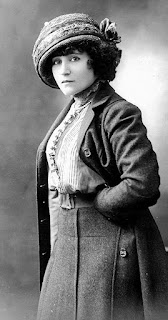
Born in the Burgundy village of Saint-Saveur-en-Puisaye to a war hero father and his wife, the family was orginally prosperous but suffered finanical reversals. She married in 1893 to Henri Gauthier-Villars ("Willy"), a writer and publisher 14 years her senior. Her first 4 books (the "Claudine" titles) were published under his name and copywright. When they separated in 1906 (and later divorced in 1910), she had no income from her own writings. She worked in journalism and on the music hall stage, as well as practicing as an amateur photographer. She also had relationships with several women, including the famous Natalie Barney, as she continued her writing.
In 1912, she married Henri de Jouvenal, and in 1913 had her daughter ('Bel-Gazou"). She published her very popular (and scandalous!) Cheri in 1920, and her writing career took off quickly. She was divorced again in 1924, and in 1925 married Maurice Goudeket, who was her husband for the rest of her life.
The 1920s and '30s were very productive for her work, and she was acclaimed as France's greatest female writer. She was 67 when the Germans occupied France, and she stayed in her Paris apartment on the Palais-Royal despite the arrest of her Jewish husband in 1941 (he was quickly released, and they spent the rest of the war quietly). In 1944, she wrote her most famous work, Gigi. Postwar, she was famous but ill with arthritis, nursed by her husband, and continued to write. (She was nominated for the Nobel Prize in literature in 1948). When she died on August 3, 1954, she was the first French woman of letters to receive a state funeral, and was buried in Pere Lachaise.
A couple of sources for her fascinating life:
Judith Thompson, Secrets of the Flesh: A Life of Colette (1999)
Annie Goetzinger, The Provocative Colette (2018)
Barnes & Noble is having a pre-prder sale through the 28th! You can use it for "Winning Back His Duchess," if you feel so inclined 😀


O my Luve is like a red, red rose
That’s newly sprung in June;
O my Luve is like the melody
That’s sweetly played in tune.
So fair art thou, my bonnie lass,
So deep in luve am I;
And I will luve thee still, my dear,
Till a’ the seas gang dry.
Till a’ the seas gang dry, my dear,
And the rocks melt wi’ the sun;
I will love thee still, my dear,
While the sands o’ life shall run.
And fare thee weel, my only luve!
And fare thee weel awhile!
And I will come again, my luve,Though it were ten thousand mile.
Orange Pineapple Margarita
2 oz Tequila1 oz Triple Sec1 oz Fresh Orange Juice2 oz Pineapple Juice1/2 oz Fresh LimeCombine all in a shaker with ice. Mix it up and pour into a rimmed glass...

When I started writing Violet’s story, I was so excited to combine two of my old passionate interests into one book—the history of the British royal family, and nineteenth century Russia! I also got to bring in another interest of mine, which might not really seem to fit into the 1870s—1930s screwball comedies! I love it when strait-laced Cary Grant begins to enjoy life thanks to Katherine Hepburn or Irene Dunn, learning to have fun at last. I also got to learn something quite new to me, Victorian photography.
Much like Prince Charles and Lady Diana in the 1980s, Prince Alfred (second son of Queen Victoria, a career naval officer) and Grand Duchess Marie, only daughter of Tsar Alexander II (who had many, many sons!) was the wedding of the year. They met in 1868, but neither family approved of the match, and they didn’t marry until January1874. It was a very lavish wedding at the Winter Palace, an Orthodox ceremony followed by an Anglican blessing, then a banquet for 700 and ball for 3000 until the early hours of the morning. It was the sensation of the newspapers, with a Who Is Who guest list of people like the Prince and Princess of Wales, Princess Royal Vicky and her husband, Prince Arthur, and the elderly Ernst, Duke of Saxe-Coburg (who had no legitimate children so Alfred eventually was his heir). (For more wedding details, I love the sadly now defunct blog, Order of Sartorial Splendor, whose archives are a gold mine!).

(One quick note on the photographic exhibit Violet visits—it’s based on a famous display in 1864, a “Bazaaar for the benefit of female artists” at the Horticultural Gardens at Chiswick. The photographers Julia Cameron, Clementina Hawarden, Lewis Carroll, and Oscar Rejlander are of course real figures, as are the royal family.)
If you’re curious about the time period, I loved these sources for further study! And visit me at ammandamccabe.com for more info!
Photography
Todd Gustavson, Camera: A History of Photography (2009)
Alma Davenport, The History of Photography: An Overview (1991)
Bruce Bernard, Photo Discovery: Masterworks of Photography 1840-1940 (1980)
Victoria Olson, From Life: Julia Margaret Cameron (2003)
Victorian Giants: The Birth of Photography (exhibition catalog)
BEC Howarth-Loomes, Victorian Photography (1974)
Royalty
Daphne Bennett, Queen Victoria’s Children (1980)
John Van Der Kiste, Alfred: Queen Victoria’s Second Son (2013)
Julia Baird, Victoria the Queen (2016)
Adrian Tinniswood, Behind the Throne: A Domestic History of the British Royal Household (2018)
Daphne Bernard, Vicky: Princess Royal of England and German Empress (1971)
Jane Ridley, The Heir Apparent: A Life of Edward VII (2013)
Marie, Queen of Romania, The Story of My Life (reprint 2019)
Richard Hough, Edward and Alexandra
Russia
Stefano Papi, Jewels of the Romanovs (2010)
Mathilde Kschenssinskaya, Dancing in Petersburg (1961)
The Last Grand Duchess: Memoirs of Grand Duchess Olga (1964)
Russia: Art, Royalty, and the Romanovs
Susan McCaffray, The Winter Palace (2018)
A little late in the weekend, but better late than never!!! I hope you all had a lovely holiday season. I've finally put the decorations away, and am digging out to try and concentrate on writing the new book. In the meantime, here are a few fun reads I've come across lately...
Legendary Nights With The Bright Young Things
The Duchess of Cambridge Turns 40!
Everyone Is Dressing Like A Bookstore Regular
The Great Sidney Poitier Passed Away
The Last Letter Of Mary Queen Of Scots
Walt Disney Borrowed From 18th Century France For Princess Culture
When Montmartre Was Harlem On The Seine
An Intimate Glimpse Of Frida Kahlo's Blue House
Santa Fe's La Fonda On The Plaza Turns 100 (I used this gorgeous place a lot in my Santa Fe 1920s Mysteries!)

Edith Piaf - La vie en rose (Officiel) [Live Version] - Bing video


