Sunday, March 25, 2018
Book winners!
The winner of the Amanda Allen/Dorothy McFalls drawing is--Bookluver88! Please email me at amccabe7551 AT yahoo, and let me know your snail mail address....

Saturday, March 17, 2018
Book Signing!
If you happen to be in the Albuquerque, NM area, I will be signing Santa Fe Mourning at Page One Bookstore tomorrow at 3:00! Come by and say "hi"--there will be bisochitos (though probably not quite as good as Juanita's...)
Info here!
Info here!
Thursday, March 15, 2018
Fashions
One of the reasons I wanted to write about the 1920s period for my new mystery series is a very shallow one--I LOVE the clothes! I keep a Pinterest board of all dresses/hats/shoes of the period I think Maddie might wear (must be fashionable but also artsy, just like her), and it's a lot of fun to imagine her wardrobe. (I also love Pinterest in general because it's an excuse to procrastinate when I'm meant to be writing or exercising. It's Very Important Research!)
Here are a few of Maddie's fantasy outfits:


Here are a few of Maddie's fantasy outfits:


Tuesday, March 13, 2018
Book Launch Day!!!
Today is that most exciting of author days--a new book is toddling its way out into the world! I'm particularly excited about this new series, written as my Amanda Allen self, because it has to of my favorite things--my hometown of Santa Fe, New Mexico, and the 1920s. My friend and fellow Crooked Lane Mysteries author Dorothy McFalls is joining me to talk about her own book release, and a town that holds her heart. Comment on this post (or any for the rest of the week, where I'll be talking about the history and characters behind my book!) for a chance to win signed copies of either book (Dorothy will be giving away the first in her series, Asking for Truffle....)
From Amanda:
 I've lived in Santa Fe with my husband, dog, and cat for just a few years, but I feel like I've been here my whole life! My family started visiting Northern New Mexico (mostly Santa Fe and Taos) since I was about 3, and the place has been in my heart ever since. It's a special land, with many different kinds of natural beauty (mountains, deserts, forests) and endless, bright blue skies. It's filled with history, as well, the blending (harmonious and sometimes distinctly not so) of Spanish, Native American, and Anglo culture. It's also a mecca for artists and writers, creative people of all sorts. In the summer, I'm constantly going to the opera, chamber music concerts, and free music on the Plaza (which my dog Abigail also enjoys!0, as well as enjoying the great restaurants. For a town of less than 70,000, it's a lot in a little.
I've also always loved the 1920s. 10 short years full of astonishing change! New fashions, new haircuts, innovative music, cars, bootlegging. Coco Chanel! Phryne Fisher! (okay, she is fictional, but I love her). What's not to love?? But as I looked deeper, I saw it had a dark side, too. The war, a terrible war that claimed millions of lives and left families devastated, was just over, along with a flu outbreak that killed millions more. The certainties of old ways of life were gone forever, and no one knew what was going to replace them yet. A person couldn't even get a legal cocktail to forget the pain! (though there was always laudanum...) It seemed like the perfect time for a murder mystery, and so I switched from my Elizabethan Mysteries series (another time period of enormous change and progress, which I also love) to 1922.
 Maddie Vaughn-Alwin is a young woman, but she's seen upheaval for herself. Born into a wealthy New York family, she always felt different. She wanted to be an artist, not a society matron, and to marry her childhood sweetheart. Her husband killed in the war, she leaves NYC for a new world, a world where she can find new freedom--Santa Fe. Far from the culture mecca it is now, with million dollar vacation homes and tony shops, it's a dusty small town with great natural beauty (and cheaper lodgings--I often wished I had a time machine to go back, scoop up a place on Canyon Road, and then come back to the present with deed in hand, LOL). It's also full of free spirits just like her, artists, writers, and family black sheep who feel they've found a new home where they can be themselves. And Maddie does, too--until her housekeeper Juanita's husband is killed at La Fonda, the nicest hotel in town, and his teenaged son is accused of the crime. Then she glimpses the darker side of her new home.
I hope you'll enjoy Maddie's journey as much as I have! For the next week, I'll be posting about the history of some of the real-life places I've used in Santa Fe Mourning--La Fonda, the Museum of Art, Canyon Road, even my favorite grocery store, Kaune's (still in business!)
From Dorothy:


From Amanda:

I've also always loved the 1920s. 10 short years full of astonishing change! New fashions, new haircuts, innovative music, cars, bootlegging. Coco Chanel! Phryne Fisher! (okay, she is fictional, but I love her). What's not to love?? But as I looked deeper, I saw it had a dark side, too. The war, a terrible war that claimed millions of lives and left families devastated, was just over, along with a flu outbreak that killed millions more. The certainties of old ways of life were gone forever, and no one knew what was going to replace them yet. A person couldn't even get a legal cocktail to forget the pain! (though there was always laudanum...) It seemed like the perfect time for a murder mystery, and so I switched from my Elizabethan Mysteries series (another time period of enormous change and progress, which I also love) to 1922.

I hope you'll enjoy Maddie's journey as much as I have! For the next week, I'll be posting about the history of some of the real-life places I've used in Santa Fe Mourning--La Fonda, the Museum of Art, Canyon Road, even my favorite grocery store, Kaune's (still in business!)
From Dorothy:

Back in the early 1990s, my husband and I designed and built a small one-bedroom beach house on the somewhat overlooked, artsy island of Folly Beach in South Carolina. We made our home there for the next twenty years. When we moved there, the town was still attracting those who saw the world a little differently. It was a hotspot for surfers, artists, and those who simply didn’t want to subscribe to society’s norms. It’s also a place for vacationers to flock to in the summer. Most of the houses around us were vacation rentals. Our joke to ourselves was always, “Don’t like your neighbors? Wait a week. You’ll get new ones.” It’s been quite a shock to move into a neighborhood and have to learn to deal with neighbors who aren’t transient.
I love this little island town with its downtown that spans just a few blocks. I love that it’s not a perfect resort community. There are still shacks interspersed among the newly built beachfront mansions, although those are rapidly disappearing. One this island you can find a house that was built around an old ship. You can also find the house where Gershwin stayed while writing Porgy and Bess. It’s not a fancy mansion, but a modest island home.
There’s a wildness to the island. The lawns aren’t neatly manicured. There’s a time in the spring when the islanders know to stop mowing in order to let the wildflowers grow and bloom. Bobcats, minks, raccoons, otters, and eagles have all visited our tiny yard.

When I set out to write my latest mystery series, the Southern Chocolate Shop Mystery series, I knew I wanted to feature this town and the quirky residents it’s attracted over the years. But I couldn’t really set it on Folly Beach, because the town I’d moved to and fell in love with twenty years ago is rapidly changing. As pressure to develop the coastline increases, the specialness and the undeveloped nature of the island is slipping away. So I decided to set the series on Camellia Beach, which is inspired by my experiences on Folly Beach. But it’s an island caught in the net of time. It’s more like the Folly Beach that existed in the past instead of even the Folly Beach that I left three years ago after my daughter was born.
At first glance, my main character Charity Penn, sees Camellia Beach as many viewed Folly Beach for years—a shabby community with very little value. But the more time she spends in this special little town, the more she comes to value the untouched and unpolished nature of the community. Within the confines of this series, I hope to capture and preserve a piece of Main Street Americana that is slowly disappearing from our nation’s landscape.

In Playing with Bonbon Fire, the second book in the Southern Chocolate Shop Mystery series, Penn is at it again—cooking up treats while working to keep everyone town of Camellia Beach safe. A threatening note, a dead musician, and decades of secrets put the town’s first beach music festival and its band members in grave danger. With the help from her meddling half-sister and a new flavor of chocolate sweets to ignite the senses, Penn follows the shifting tide of evidence to uncover a long-buried secret.
Dorothy St. James, known for the White House Gardener Mystery series, has gone back to her roots and setting a mystery series in a Southern beach town much like the one she’s called home for the past 20 years. The Southern Chocolate Shop Mysteries combine her love of fine chocolates, quirky Southern charm, with a dash of danger. Asking for Truffle is the first book in this exciting new series. Playing with Bonbon Fire came out in March 2018 and In Cold Chocolate is scheduled to release September 2018.
What are some places that have been special in your life? And most important--what kind of chocolate is your favorite???
What are some places that have been special in your life? And most important--what kind of chocolate is your favorite???
Sunday, March 11, 2018
Royal Wedding of the Weekend

Today we'll take a look at the grandparents of last week's bride, Princess Mary, on their anniversary (March 10, 1863), Edward VII and Queen Alexandra.
Alexandra's early life sounds something like a Cinderella tale. Even though she was the daughter of the Danish king, and enjoyed a very close-knit family upbringing, the Danes were an obscure and not very wealthy royal family, especially compared with the might of the British Empire and Queen Victoria. But the queen and the late Prince Albert had always despaired of their eldest son, thinking him debauched and not serious, and they were sure marrying and settling down early would do him good. After Albert's death, Victoria turned to her eldest daughter Princess Vicky, now settled in Prussia, to find the right bride for Albert Edward (Bertie). The queen wanted a German bride, but none were deemed pretty enough. In fact, the only one who would do was the gorgeous Alexandra, then 16 years old. A meeting was arranged, and a betrothal swiftly followed.

Alexandra was Princess of Wales until 1901, the longest to ever hold that title, and proved to be a very popular and stylish royal. Despite Bertie's constant infidelities and her own health troubles (including growing deafness), they had 6 children and a relatively harmonious life together. Bertie died in 1910, after a mere few years as queen, and Alexandra in 1925.
Monday, March 05, 2018
Royal Wedding
So, it's not the weekend, but since I was tearing my hair out with deadlines, we have our royal wedding today! I thought, since their anniversary is just past, we could look at Princes Mary, the Princes Royal, and Viscount Lascelles. They are little known today, but at the time their wedding was a source of much fashionable fascination.
 Princess Mary was born Victoria Alexandra Alice Mary (but always called Mary) in 1897, the only daughter and third child of George V and Queen Mary, at the time the Duke and Duchess of York. (it was the year of Queen Victoria's Diamond Jubilee, and she suggested the baby be called "Diamond." Luckily, this was ignored). She became Princess Royal in 1932. All her life she was an enthusiastic patron of charities, especially hospital and the Girl Guides, who she led from 1920 until her death.
She was the first of her siblings to marry. In November 1921, she became engaged to Henry, Viscount Lascelles, son of the Earl of Harewood, who was 15 years older than herself, and who it seems she hadn't really known very long. (There were later rumors the marriage was not very happy, but their son declared they "got on well together, and had a lot of friends and interests in common"). Queen Mary wrote after the engagement:
“At 6.30 Mary came to my room to announce to me her engagement to Lord Lascelles! We then told G. (King George V) & then gave Harry L. our blessing. We had to keep it quiet owing to G. having to pass an order in council to give his consent. Of course, everybody guessed what had happened & we were very cheerful & almost uproarious at dinner. We are delighted.”
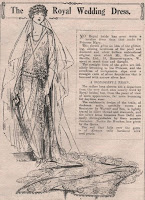 They were married at Westminster Abbey on February 28, 1922, the first marriage of the child of a monarch there since 1290. Her gown was quintessentially 1920s, dropped waist, bandeau headpiece, pearl beadwork, created by Reville LTD of Hanover Square. Lady Elizabeth Bowes-Lyons, a few years later to be the princess's sister-in-law, was one of the bridesmaids.
The couple, later Earl and Countess of Harewood, had two sons. The earl died in 1947, and Princess Mary in March 1965.
You can see a list of her truly eye-popping collection of wedding gift jewels here
There is also a fascinating story of the journey of Queen Victoria's sapphire bandeau (one of those gifts) here

She was the first of her siblings to marry. In November 1921, she became engaged to Henry, Viscount Lascelles, son of the Earl of Harewood, who was 15 years older than herself, and who it seems she hadn't really known very long. (There were later rumors the marriage was not very happy, but their son declared they "got on well together, and had a lot of friends and interests in common"). Queen Mary wrote after the engagement:
“At 6.30 Mary came to my room to announce to me her engagement to Lord Lascelles! We then told G. (King George V) & then gave Harry L. our blessing. We had to keep it quiet owing to G. having to pass an order in council to give his consent. Of course, everybody guessed what had happened & we were very cheerful & almost uproarious at dinner. We are delighted.”

The couple, later Earl and Countess of Harewood, had two sons. The earl died in 1947, and Princess Mary in March 1965.
You can see a list of her truly eye-popping collection of wedding gift jewels here
There is also a fascinating story of the journey of Queen Victoria's sapphire bandeau (one of those gifts) here
Pre-order!
The first book in my "Debutantes in Paris" series, Secrets of a Wallflower, is available now!!!! I always love the beautiful covers at Harlequin Historicals, but I think this one is my favorite (because of the Eiffel Tower, of course!)

A secret shared…
But can she trust him?
In this Debutantes in Paris story, Diana Martin is thrilled to be a writer covering the Parisian Exposition. But her new role must be kept quiet—her parents would never allow it! When enigmatic Sir William Blakely discovers her ruse, he knows it could lead her into danger. With the sparks igniting between them, William realizes the only way to protect Diana is by staying as close to her as possible!
Debutantes in Paris miniseries
Book 1 — Secrets of a Wallflower
Look out for the next book, coming soon!
“McCabe sets the perfect tone, complete with all the elegant trimmings and sparkling warmth such genre fantasy can capture” — RT Book Reviews on The Wallflower’s Mistletoe Wedding
Out in June, but you order anytime here....

A secret shared…
But can she trust him?
In this Debutantes in Paris story, Diana Martin is thrilled to be a writer covering the Parisian Exposition. But her new role must be kept quiet—her parents would never allow it! When enigmatic Sir William Blakely discovers her ruse, he knows it could lead her into danger. With the sparks igniting between them, William realizes the only way to protect Diana is by staying as close to her as possible!
Debutantes in Paris miniseries
Book 1 — Secrets of a Wallflower
Look out for the next book, coming soon!
“McCabe sets the perfect tone, complete with all the elegant trimmings and sparkling warmth such genre fantasy can capture” — RT Book Reviews on The Wallflower’s Mistletoe Wedding
Out in June, but you order anytime here....
Saturday, February 17, 2018
Royal Wedding of the Weekend
Hello, everyone! We continue our celebration of all things royal wedding (since 2018 will bring is not one but two royal nuptials in England!) with a look at one of the most famous royal unions of all time, Victoria and Albert, who celebrated an anniversary this week (178 years!), and also because I am avidly watching "Victoria" on PBS. :)
 Queen Victoria married her Prince Albert on February 10, 1840. When she first met her cousin (her mother was his father's sister, and the match was long schemed about amongst the Coburgs), in April 1836, Victoria wrote to her Uncle Leopold to thank him for "the prospect of great happiness you have contributed to give me in the person of dear Albert!" But she became busy being queen, and the match didn't happen until 1839, when Albert was summoned to England and Victoria proposed (as per protocol). In her diary, she declared "To feel I was, and am, loved by such an Angel as Albert was too great a delight to describe! How I love and adore him I cannot say." Preparations were not all smooth, as not everyone wanted a foreign prince, and there was wrangling over incomes, titles, and precedence. But at last the day was set--February 10.
The wedding was the first marriage of a queen regnant since Mary I, and the country was soon caught up in wedding fever. The day was a cold, rainy one, but it didn't stop crowds from gathering to watch the royal carriages go by on their way to the Chapel Royal, St. James's Palace. The queen wore a gown of white English satin (an unusual but not unique choice, which set a new trend that lasts to this day) trimmed with Honiton lace flounces, a matching lace veil (which she would later be buried with) held with a wreath of orange blossoms, a diamond necklace and earrings, and a sapphire brooch that was Albert's gift. (She described it as "I wore a white satin dress with a deep flounce of Honiton lace, in imitation of an old design"). Albert wore an English field marshal's uniform, and walked down the aisle to Handel. Victoria was given away by her uncle, the Duke of Sussex, and 12 bridesmaids carried her 18 foot train.
A wedding breakfast was held at Buckingham Palace, the queen's newly renovated home, complete with a 300 pound cake iced in white. "The happiest day of my life," she declared, and after the wedding night sighed, "I never, never spent such an evening." Two months later she was pregnant with the first of 9.
The very happy, if sometimes stormy, marriage, a true partnership, sadly only lasted 21 years, when Albert died at age 42 in 1861.
A couple of great sources about the royal marriage are:
Julia Baird, Victoria: The Queen (2016)
Gillian Gill, We Two: Victoria and Albert (2009)

The wedding was the first marriage of a queen regnant since Mary I, and the country was soon caught up in wedding fever. The day was a cold, rainy one, but it didn't stop crowds from gathering to watch the royal carriages go by on their way to the Chapel Royal, St. James's Palace. The queen wore a gown of white English satin (an unusual but not unique choice, which set a new trend that lasts to this day) trimmed with Honiton lace flounces, a matching lace veil (which she would later be buried with) held with a wreath of orange blossoms, a diamond necklace and earrings, and a sapphire brooch that was Albert's gift. (She described it as "I wore a white satin dress with a deep flounce of Honiton lace, in imitation of an old design"). Albert wore an English field marshal's uniform, and walked down the aisle to Handel. Victoria was given away by her uncle, the Duke of Sussex, and 12 bridesmaids carried her 18 foot train.
A wedding breakfast was held at Buckingham Palace, the queen's newly renovated home, complete with a 300 pound cake iced in white. "The happiest day of my life," she declared, and after the wedding night sighed, "I never, never spent such an evening." Two months later she was pregnant with the first of 9.
The very happy, if sometimes stormy, marriage, a true partnership, sadly only lasted 21 years, when Albert died at age 42 in 1861.
A couple of great sources about the royal marriage are:
Julia Baird, Victoria: The Queen (2016)
Gillian Gill, We Two: Victoria and Albert (2009)
Sunday, January 28, 2018
Royal Wedding of the Weekend

Today's wedding was neither fun nor very festive. On June 3, 1937, the ex-King Edward VIII turned Duke of Windsor finally married his longtime love, American divorcee and fashionista Wallis Simpson. It had been a rocky road of illicit romance and a shocking abdication, a match that nearly ran off the rails several times, but Edward couldn't live his life without "the woman I love." (Luckily for England, facing a grueling war, they got the exemplary King Georve VI and Queen Elizabeth the Queen Mother).
The wedding was completely lacking in royal pomp, and was short and simple. It took place at the Chateau de Cande in Monts, France, performed by the mayor of Monts for the required civil ceremony, and Reverend R. Anderson Jardine for the Anglican rites. (It was very hard for them to find a priest to perform the marriage, and poor Jardine paid the price in his career thereafter). There were only a few guests, including Randolph Churchill (whose father secretly liked and supported the prince, until it became impossible), and best man "Fruity" Metcalfe. Herman Rogers, husband of one of Wallis's old friend, a couple who gave her shelter during the abdication, walked her down the aisle to Handel. The ceremony was held in the music room, with a makeshift altar of an oak chest covered with a tablecloth and laid with a gold cross and candles.

The short ceremony was followed by champagne toasts, some photos on the terrace, and a ride to their honeymoon at Wasserloenberg Castle in Austria, where he carried his bride over the threshold. They were married until his death in 1972, long years of scandal, wandering, and cafe society. Maybe a sort of HEA for them.
For a romanticized view of the couple, I enjoy the duchess's own book, The Heart Has Its Reasons, and Diana, Lady Mosley's The Duchess of Windsor: A Memoir. I also liked Anna Sebba's recent bio That Woman
Saturday, December 23, 2017
Royal Wedding of the Weekend

They met when they were only teenagers, and in the middle of some of the biggest dramas of medieval England. Edward's father, Edward II, had long been a bad ruler, controlled by a series of venal favorites, and Prince Edward's French mother Isabella, dispossessed of her dower and separated from her children, had enough. She managed to get back to France, seek her brother the French king's help, and refused to return to England. What was more, she got control of her eldest son, the heir to the throne, when he joined her in Paris (a major miscalculation on her husband's part). One of her main objectives was to organize the prince's marriage to bring benefit to her own cause, and in 1326, then Edward was 14, she took him to Hainault to take a look at the count's five daughters, thinking he could marry one in exchange for his assistance in her English coup.
Philipa was a couple of years younger than Edward, the second daughter, dark-haired, a bit plump, kind-hearted and sensible. A chronicler of the time described her thus:
The lady whom we saw has not uncomely hair, betwixt blue-black and brown. Her head is clean-shaped; her forehead high and broad, and standing somewhat forward. Her face narrows between the eyes, and the lower part of her face is still more narrow and slender than her forehead. Her eyes are blackish-brown and deep. Her nose is fairly smooth and even, save that it is somewhat broad at the tip and also flattened, and yet it is no snub-nose. Her nostrils are also broad, her mouth fairly wide. Her lips somewhat full, and especially the lower lip. Her teeth which have fallen and grown again are white enough, but the rest are not so white. The lower teeth project a little beyond the upper; yet this is but little seen. Her ears and chin are comely enough. Her neck, shoulders, and all her body are well set and unmaimed; and nought is amiss so far as a man may see. Moreover, she is brown of skin all over, and much like her father; and in all things she is pleasant enough, as it seems to us. And the damsel will be of the age of nine years on St. John's day next to come, as her mother saith. She is neither too tall nor too short for such an age; she is of fair carriage, and well taught in all that becometh her rank, and highly esteemed and well beloved of her father and mother and of all her meinie, in so far as we could inquire and learn the truth
But Edward and Philipa grew very fond of each other. He was sorry to part with her when he and his mother left, and Philipa was said to have cried. They were a rare royal couple who got to know each other a bit before the marriage! When the time came to arrange a betrothal, he was strongly in favor of Philipa being the chosen bride, and so she was. When Edward II was overthrown and Edward III proclaimed in his place, a proxy marriage took place, and Philipa left for England. In January 1328, the wedding took place at York Minster, the last royal marriage there until the Duke and Duchess of Kent in 1961. They were married 40 years until Philipa's death in 1369.
The marriage might have started off strong, and stayed that way (they were very well-matched, both interested in hunting, festivities, travel, romantic stories, and family life), but the beginning of heir reign was rocky. Edward was young, and for a few years real rule was carried out by his mother and her lover Roger Mortimer. Philipa was not given her dower, and her coronation was delayed for two years (she was six month pregnant with their first son, the Black Prince, when it happened). Edward finally managed to overthrow his mother and take the throne for himself. The couple went on to have 13 children, and were often on the move together between Scotland, France, and Flanders. Edward was devastated when his wife died, and quickly descended into dementia. They are buried together at Westminster Abbey.
A good source for this exciting reign is Ian Mortimer's Edward III: The Perfect King
Friday, December 22, 2017
Pre-orders!!!
My newest alter-ego, Amanda Allen, has her first book up for pre-order!!! (It will be available in paperback next November, hardback and ebook in March). I am so very excited for this series, since it's set in one of my favorite time periods (the 1920s) in my own hometown, Santa Fe. Maddie is an artist, WWI widow, fashionista, and all around fun lady to write about! If you need a last minute Prezzie (you can tuck the receipt in someone's stocking, and tell them they get a great gift in the spring) look no further. :) (you can order here--Allen website coming soon...)
(if you would like a review copy, let me know at amccabe7551 AT yahoo)

(if you would like a review copy, let me know at amccabe7551 AT yahoo)

Saturday, December 16, 2017
Royal Wedding Weekend: Queen Mary Tudor
Have you heard the news?? (I know you have!) Prince Harry and Meghan Markle will be married at St. George's Chapel, Windsor, on May 19, and I am SO excited at the news. To celebrate, I've decided to blog about a few royal weddings of the past. Some ended happily, many did not, but there were always beautiful clothes, pageantry, and some kind of hope for the future.
 We'll start in the 1500s, with the wedding of Queen Mary Tudor and Philip II of Spain, on July 25, 1554. Mary had not been queen long, after her dramatic accession, and she was eager to marry. She was 37, loved children, and really wanted to be a traditional wife, which she had been denied for her whole life. There were also the concerns of state, the need for an heir. But her choice was not a popular one. Encouraged by her cousin and longtime mentor, Charles V, and with nostalgic memories of her Spanish mother, she determined to marry Charles's son Philip II. Philip was 10 years younger but already a widower, and said to be very handsome. Mary's council, and most of the country's population, were not big on foreigners, and had qualms that the two would unite in their uber-Catholicism. Mary brushed them off, maybe already somewhat infatuated with the idea of a bit of romance in her life at long last, and declared she would marry him. After quelling some anti-Spanish riots, she did just that.
The royal couple married at majestic Winchester Cathedral two days after meeting (Mary was enthusiastic; Philip less so, but no doubt being declared King of England made him happy enough). As Philip spoke no English, the service was conducted in a mix of Latin, Spanish, and English, and it was hours long and quite grand. Philip wore "breeches and doublet were white...over all a mantle of cloth of gold...ornamented with pearl and precious stones, and wearing the collar of the Garter." The cathedral itself was "richly hanged with arras and cloth of gold," with a dais draped in scarlet and set with two thrones. (Philip had been declared King of England, to rule alongside his wife).
 Mary herself wore a dress of the French style, "rich tissue with a border and wide sleeves, embroidered upon purple satin, set with pearls," and a kirtle and train of white and silver satin. (A splendid replica was made to be displayed at the cathedral)
The ceremony was followed with a lavish banquet and dancing, amid the uneasy mixing of Spanish and English courtiers (the Spanish didn't think much of Mary's looks), and then the marriage bed was blesed by Archbishop Gardiner and the couple put to bed. The marriage was almost certainly consumated, because a few months later Mary thought herself pregnant, her blessing from God complete. (It turned out to be a false pregnancy, a humiliating blow Mary never recovered from). The marriage was marred by war, illness, and long separations, though Mary was devoted to her husband.
When Mary died in 1558, Philip was in Brussels and had not seen her in many months. He declared he felt a "reasonable regret" for her death, and later tried to court her half-sister Elizabeth, and then married a French princess. Much later, he went to war with the country where he was so briefly king, with the disastrous Armada. I always feel so sorry for Mary.
There are many interesting biographies of Mary and Philip, but a couple of my favorites are:
Linda Porter, Mary Tudor: The First Queen
Anna Whitelock, Mary Tudor, England's First Queen
You can see more about the Act of Marriage here.https://en.wikipedia.org/wiki/Act_for_the_Marriage_of_Queen_Mary_to_Philip_of_Spain..
 (and on a totally different note, if you are in the mood for a Regency Christmas read, my Wallflower's Mistletoe Wedding is still available!! I promise it's a lot more fun than the fateful union of Mary and Philip....)

The royal couple married at majestic Winchester Cathedral two days after meeting (Mary was enthusiastic; Philip less so, but no doubt being declared King of England made him happy enough). As Philip spoke no English, the service was conducted in a mix of Latin, Spanish, and English, and it was hours long and quite grand. Philip wore "breeches and doublet were white...over all a mantle of cloth of gold...ornamented with pearl and precious stones, and wearing the collar of the Garter." The cathedral itself was "richly hanged with arras and cloth of gold," with a dais draped in scarlet and set with two thrones. (Philip had been declared King of England, to rule alongside his wife).

The ceremony was followed with a lavish banquet and dancing, amid the uneasy mixing of Spanish and English courtiers (the Spanish didn't think much of Mary's looks), and then the marriage bed was blesed by Archbishop Gardiner and the couple put to bed. The marriage was almost certainly consumated, because a few months later Mary thought herself pregnant, her blessing from God complete. (It turned out to be a false pregnancy, a humiliating blow Mary never recovered from). The marriage was marred by war, illness, and long separations, though Mary was devoted to her husband.
When Mary died in 1558, Philip was in Brussels and had not seen her in many months. He declared he felt a "reasonable regret" for her death, and later tried to court her half-sister Elizabeth, and then married a French princess. Much later, he went to war with the country where he was so briefly king, with the disastrous Armada. I always feel so sorry for Mary.
There are many interesting biographies of Mary and Philip, but a couple of my favorites are:
Linda Porter, Mary Tudor: The First Queen
Anna Whitelock, Mary Tudor, England's First Queen
You can see more about the Act of Marriage here.https://en.wikipedia.org/wiki/Act_for_the_Marriage_of_Queen_Mary_to_Philip_of_Spain..

Friday, November 24, 2017
Sale Today!

Order Here
Saturday, November 11, 2017
Contest Winners!
And the winners of the signed Christmas books are--RegencyGirl01, Manda Ward, Tammy Y, and Daniele K! Please send me your contact info at amccabe7551 AT yahoo, and let me know which book you would like (or both--I need to clean out these closets!)
Saturday, November 04, 2017
Contest Time!

To enter is super-easy. Comment here (what are your holiday plans?? Favorite recent reads?? Old comfort holiday reads??), or Like/Comment on my Facebook page Amanda McCabe Books, or go to my website http://ammandamccabe.com and sign up for my newsletter (they're very short and only appear 3/4 times a year, I promise!), just mention you'd like to be entered in the contest. Or do all three for more chances to win!!

p.s. The contest will run to the end of the week, winners chosen on Saturday!
Sunday, July 23, 2017
(Fictional) Heroine of the Weekend: Amelie

So this weekend I am taking a look at one of my very favorite (and upbeat!) movies of all time, Amelie, starring the adorable Audrey Tautou, from 2001. This is of my favorites not just because it's set in my very favorite city (and it's a very Parisian movie), but because the heroine just makes me--smile. Which is her mission in life.
According to Rotten Tomatoes, "Amelie is a fanciful comedy about a young woman who discreetly orchestrates the lives of the people around her, creating a world of her own making." And she does this despite her own paralyzing shyness, thanks to an active imagination, a whimsical sense of mischief (the bit where she cracks the creme brulee with her spoon ad then smiles is gorgeous!). She returns a precious childhood box to an old man, leading to a reunion with his estranged family; matchmakes foe co-worker, Gina, with hilarious and ultimately disastrous results, helps a bullied shopworker; and even gets her widowed father to follow his dreams of travel using his garden gnome.
With the help of her disabled neighbor, Monsieur Dufayel, who paints Renoir's Luncheon of the Boating Party over and over, though he can never figure out the girl drinking from the water glass, Amelie even comes out of her own shell. The girl in the painting, and Amelie herself, have been frozen by their own fears. She releases herself, and finds love with the equally quirky Nino (after a series of bizarre courting games!)
It was nominated for the Best Foreign Language Film at the Oscars, and won the French Cesar Award. If any movie is guaranteed to make me feel #upbeat, it's this one! What is yours?
Saturday, July 22, 2017
New Cover Alert!
The cover for my November release, The Wallflower's Mistletoe Wedding, is finally here! And, even though it's about 90 degrees in the shade here, it reminds me Christmas is just around the corner:


A country Christmas at Barton Park
Plain, sensible Rose Parker is a self-proclaimed wallflower, but she's always dreamed of dancing with Captain Harry St George…
Once, Harry wouldn't even have noticed Rose. But now, after a hard war, Harry knows he's a different man. Shy, sweet Rose intrigues him more than any gregarious young lady—but he must marry a rich bride to save his mortgaged estates…and Rose is no heiress. Now, more than ever, Harry needs the magic of a mistletoe kiss…
(If you're already feeling in the holiday spirit, it's up for pre-order here!)
Sunday, July 02, 2017
Tiara of the Weekend
Instead of a heroine this weekend, I'm taking a look at a tiara that has belonged to several queenly heroines, Queen Alexandra's kokoshnik. The Order of Sartorial Splendor site (one of my my very favorites, and a must-read for anyone obsessed with royalty like I am!) called it a "straight-up wall of diamonds." If you know me at all, you know how much I am bound to LOVE that! In fact, I loved it so much I had to put it in a scene of my new WIP last week, when Alexandra has a walk-on role. (the new book is set in Paris during the Exposition of 1889, when the Prince and Princess of Wales made an "incognito" visit to take in the sites. She only has a cameo role, but of course that required an afternoon of heavy research to decide on her jewels!)
 In 1888, Queen (then Princess of Wales) Alexandra and her husband celebrated their Silver Wedding anniversary, which called for some heavy-duty gifts. A committee called the Ladies of Society, led by 2 marchionesses and 2 countesses, raised a collection for a present of jewels, and Alexandra requested a tiara in the style of a kokoshnik, like those worn by her sister, Empress of Marie of Russia. The Ladies commissioned royal jeweler Garrard, who designed the tiara, like Marie's, in a style of individual pave-set bars of diamonds (77 bars, with 400 diamonds in total), which could also be worn as a necklace. The cost was 4400 pounds, and the royal family has since gotten their money's worth out of it. It's been a favorite piece of 3 queens, with hopefully many more to come.
 The tiara had its first big outing in 1893, when Alexandra wore it to the wedding of her son George to May of Teck. When she passed in 1925, May became Queen Mary, and inherited her mother-in-law's gems. She didn't often wear pieces from Queen Alexandra, being a first-class jewel magpie of her own, but the kokoshnik was a favorite of hers, too. In 1953, the current queen inherited her grandmother's collection, and has often worn the kokoshnik to state banquets, foreign tours, and the theater (it's second only to the Girls of Great Britain and Ireland tiara in terms of wears). I would love to see it on the Duchess of Cambridge one day! It's a "wall of diamonds," but it also has a lightness and elegance about it, a timelessness, that's hard to beat.


Saturday, June 24, 2017
Heroine of the Weekend: Edith Cavell
(I'm currently at the Historical Novel Society conference--more on that next week when I am home and over Conference Fatigue, lol! But today we have a Heroine for a belated Memorial Day tribute, Nurse Edith Cavell, who lost her life in WWI)
 Edith Cavell (1865-1915) was a vicar's daughter, educated at Norwich School for Girls, who started her working career as a governess in Belgium (which gave her a lifelong love for the country, where she could indulge in interests in art and her facility for languages) before returning for nurse's training in London and jobs in various hospitals, where she as always seen as a compassionate and efficient medical professional. She was recruited to be matron at a new nurses' training school in Brussels, and by 1910 had launched nursing journals, recruiting nurses for over 3 hospitals and 24 new branches of the school, just in time for the huge demand of World War I.
The Red Cross took over the hospital when the war started, and Cavell became a war nurse. She also helped wounded British soldiers out of occupied Belgium into the Netherlands, becoming part of a large network of underground escape routes. She was arrested by the Germans on august 3, 1915 and charged with harboring Allied soldiers.
She was held in prison for 10 weeks, confessing to sheltering 60 British and 15 French soldiers, as well as French and Belgian civilians before being condemned to death. The British diplomatic service could do nothing for her, despite the fact that she was a British national and should not have been charged with treason. On the night before she was executed, she wrote "Patriotism is not enough. I must have no hatred or bitterness toward anyone." (the words now carved on her statue in Trafalgar Square). She was executed by firing squad on October 11, and her death was a huge propaganda tool for the Allied cause.
 After the war, she was taken back to England for a service at Westminster Abbey and laid to rest at her family home in Norwich.

The Red Cross took over the hospital when the war started, and Cavell became a war nurse. She also helped wounded British soldiers out of occupied Belgium into the Netherlands, becoming part of a large network of underground escape routes. She was arrested by the Germans on august 3, 1915 and charged with harboring Allied soldiers.
She was held in prison for 10 weeks, confessing to sheltering 60 British and 15 French soldiers, as well as French and Belgian civilians before being condemned to death. The British diplomatic service could do nothing for her, despite the fact that she was a British national and should not have been charged with treason. On the night before she was executed, she wrote "Patriotism is not enough. I must have no hatred or bitterness toward anyone." (the words now carved on her statue in Trafalgar Square). She was executed by firing squad on October 11, and her death was a huge propaganda tool for the Allied cause.

Sunday, May 28, 2017
Heroine of the Weekend: Frida Kahlo
 One of the things I missed about doing this blog was finding Heroines to feature every weekend--women in history both famous and not-so-famous (and sometimes not even very heroic!), but who I found to be interesting. Today I'm taking a look at the artist Frida Kahlo, because I just happened to go to an exhibit last week centered around her life. ("Mirror, Mirror: Photographs of Frida Kahlo" at the Spanish Colonial Arts Museum). I've always been fascinated by her (as so many people are!) and loved getting a closer look at her life and style.
Frida Kahlo (1907-1954) was born Magdalena Carmen Frieda Kahlo y Calderon in Coyocoan, Mexico City, to a Mexican mother and German photographer father, and had 3 sisters, growing up in the Casa Azul (now a museum, and on my bucket list). At age 6, she was stricken with polio, bedridden for months and emerging with a pronounced limp. Her father encouraged her to get into sports, and she enrolled in 1922 at the National Preparatory School (one of the few female students), and took art classes. But her new life didn't last long. On September 17, 1925, she was horribly injured in a trolley crash, spending months in the hospital and then facing a lifetime of surgeries and constant pain. But she took that pain, that suffering, and used it in an art never seen before, one that was deeply personal, graphic, and often surreal. She also became radical in her politics, joining the Mexican Communist Party.
In 1928, she met the famous mural painter Diego Rivera, and married him the next year. They spent much time on the move for his work, living in California, New York City, and Detroit for many years. Affairs by both partners (including one by Rivera with Frida's sister), as well as several miscarriages and professional complications (Rivera was famously fired from a mural project at Rockefeller Center for sneaking in a portrait of Lenin to the image). They divorced in 1939, Kahlo then moving for a time to Paris, but remarried the next year and stayed together for the rest of Kahlo's life, though living in separate but conjoined houses/studios.

I've always been in awe of her strength, her uniqueness, her great talent, her fearlessness, and her ability to know and be true to herself. She's really a Heroine.
Subscribe to:
Posts (Atom)