Sunday, March 20, 2011

Heroine of the Weekend

This weekend's Heroine is Matilda Gage, suffragist, Native America rights activist, abolitionist and author, who died on March 18, 1898. She's not as well-known as some of the early suffragists, but was a tireless worker for human rights.

Matilda was born March 24, 1826, the daughter of abolitionist Hezekiah Joslyn, and grew up in a house that was a stop on the Underground Railroad, which established her concern for the rights of others. She lived most of her life in Fayettesville, New York, eventually marrying Henry Gage and having 5 children with him (one of her daughters, Maud, married Wizard of Oz author L. Frank Baum).

Her women's rights career was launched when she spoke at the National Women's Rights Convention at Syracuse, NY in 1852 and joined forces with Elizabeth Cady Stanton and Susan B. Anthony (though she came to be considered much more radical than them!). She went on to serve as president of the National Women's Suffrage Association 1875-77, holding other positions within the organization for 20 years. Eventually she and her supporters split off into the more extreme Women's National Liberal Union in 1890.

She became a Theosophist, who opposed the Christian church and it's opposition to a change in women's traditional roles, strongly supportingt the separation of church and state (a debate still ongoing) and publishing such works as Woman Church and State to lay out her position. She was the owner and editor of the feminist The National Citizen, and was arrested for attempting to vote in 1871. She supported Victoria Woodhull in the 1872 presidential election.

Matilda Gage died in 1898 of a stroke. She was cremated, but a memorial stone in her family plot is carved with her lifelong motto: "There is a word sweeter than Mother, Home, or Heaven. That word is Liberty."

A couple of sources on her fascinating life:
Sally Roesch Wagner, Matilda Joslyn Gage: She Whol Holds The Sky (1998)
Leila R. Brammer, Excluded from Suffrage History: Matilda Joslyn Gage, 19th Century American Feminist (2000)

Thursday, March 17, 2011

Things I Love Thursday


I just realized I haven't done a Things I Love Thursday post in a while! I need to start that again--I think I need some gratitude in my life. But this Thursday I love--St. Patrick's Day!! What's not to love? Guinness, the Chieftains, my favorite green scarf, and all things Irish. (For a brief look at St. Patrick and the history of his day, you can look here...)

And if you happen to be on Twitter, Grand Central Publishing is having a giveaway today, including my two "Daughters of Erin" books, Countess of Scandal and Duchess of Sin! Look for #4EvrStPatty. Erin Go Bragh!

(also, I'm at H&H today talking about Irish romance...)

Saturday, March 12, 2011

Heroine of the Weekend

Our heroine this weekend is Anne Hyde, Duchess of York, who was born on this day in 1637, and until Lady Diana Spencer was the only non-royal royal bride. (See how it flows into yesterday's post about the new Kate Middleton doll???)

Anne was born at Cranbourne Lodge, Windsor, but spent most of her youth in exile with the court of Charles II--her father, Sir Edward Hyde (later made an earl) was one of the king's most trusted advisers, and Anne served as a lady-in-waiting to Charles's sister Mary, Princess of Orange. On a visit to Paris with the princess, she met James, Duke of York, and the two embarked on an affair that ended in pregnancy and a secret marriage in the Netherlands in 1659. (They were "officially" remarried the next year in London, following the Restoration).

Anne was not considered beautiful, but she more than made up for it with great intelligence and energy, and a famous virtue that made her not very popular with Charles's court. She was a patron of the arts, and involved in politics and current events in a way that never interested her husband. Though the marriage was not happy (James was flagrantly unfaithful) they worked well together. The French ambassador declared Anne had "courage, cleverness, and energy almost worthy of a king's blood," while Pepys wrote "the duke, in all things but his amours, was led by the nose by his wife."

The royal couple had several children, but only two, the future queens Mary and Anne, survived. Anne Hyde died young, probably of breast cancer, soon after having her 8th child on April10, 1671, and was laid to rest at Westminster Abbey. Like her husband, she converted to Catholicism late in her life, an action that would have dire consequences when he later became king...

I wasn't able to find a biography only of her, but here are a few sources on her life:
Antonia Fraser, King Charles II
Barbara Softly, The Queens of England
The Diary of Samuel Pepys

Thursday, March 10, 2011

Kate Middleton Doll


I love royal wedding memorabilia as much as the next crazy Anglophile, but I am just not sure I would want this tiny Kate Middleton standing on the shelf staring at me all the time.... (though I confess I do have a Princess Di bride doll, my very best childhood Christmas present EVER!)

Saturday, March 05, 2011

Heroine of the Weekend

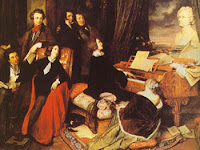
Happy weekend, everyone! Our Heroine this week (now that I have my computer woes somewhat straightened out) is French author Marie d'Agoult (who wrote under the name Daniel Stern, and is perhaps best known today for leaving her husband to run off with Franz Liszt!). She died on this day in 1876.

She was born Marie Catherine Sophie de Flavigny on December 31, 1805, to a Frenchman in exile in Germany and a wealthy German banker's daughter. After spending her childhood in Frankfurt, she was sent to be educated in a French convent after the royal family was restored to the throne, and married the comte d'Agoult in 1827. The couple had 3 daughters, but were eventually divorced in 1835 after she eloped with Liszt. Marie escaped her unhappy marriage by becoming a leading artistic hostess in Paris (attendees at her salon included Hugo, Chopin, and Rossini, among many others, and they remained her friends after she was ostracized by high society).

The notorious couple lived together from 1835 to 1839 and broke up for good in 1844, but they spent their time having children (2 daughters, including Cosima who married Richard Wagner, and one son who died young of tuberculosis) and traveling on Liszt's performance tours. Marie also became involved in writing for the liberal press of the day and starting a career in fiction. Her most sensational work was Nelida, considered to be a fictionalized memoir of her affair with Liszt, but her Essai sur la liberte (1847) was very well-received and gave her a place among such feminist philosophers as Mary Wollstonecraft and Madame de Stael.

Her Lettres Republicanes, written during the 1848 uprising, was a sensation, and she stayed involved in politics during the rest of her life. Though she is overshadowed now by her contemporary George Sand, her contributions to progressive thought, feminism, and literature shoudl not be overlooked.

She died in 1876 and was buried at Pere Lachaise cemetery.

For more information on her very eventful life, look for Phyllis Stock-Morton's The Life of Marie d'Agoult, alias Daniel Stern (2000)

Sunday, February 27, 2011

Shy Duchess launch!


Thanks to some ongoing computer issues here, no Heroine of the Weekend this week, but I am at the Riskies launching my new book The Shy Duchess (and giving away a copy!). Come visit me there....

Wednesday, February 23, 2011

Happy Birthday Handel!

Handel (one of my favorite composers!) was born on February 23, 1685...

Tuesday, February 22, 2011

National Margarita Day


Happy National Margarita Day, everyone! (You gotta love a whole day just for margaritas...)

Monday, February 21, 2011

Hottie Monday, Oscars Edtion

I am finally digging out from under the weekend's computer crisis, yay! And in honor of this weekend's Oscars ceremony, our Hottie Monday is a few nominees. Enjoy! (And who are you cheering for to win?)


Friday, February 18, 2011

Hello Kitty Mania!


How did I miss that Sephora had a new Hello Kitty line before??? Anyway, I just made up for it by ordering way too much stuff. Happy Friday to me!

Thursday, February 17, 2011

Crushes

I found this funny article on celebrities' own celebrity crushes! Who are yours???

Wednesday, February 16, 2011

My Dark Obsession


I'm sharing my deep, dark love of "Vampire Diaries" on the Heroes & Heartbreakers blog today (which is an awesome place to visit, BTW...)

Tuesday, February 15, 2011

Tuesday


Over at the Riskies today, talking about exercise and avoiding the dreaded Writer's Butt Syndrome! Also, I heard that my book To Catch a Rogue is a Cataromance Reviewer's Choice Award winner, yay....

Monday, February 14, 2011

Hottie Monday (Valentine's Day Edition)

Today's Hottie--Matthew McFadyen, because I was watching Any Human Heart on Masterpiece last night....

What are your plans for Valentine's Day???


Saturday, February 12, 2011

Heroine of the Weekend

And hopefully now we are back on blogging track for the month! This weekend's Heroine is Louisa Catherine Johnson Adams, born on February 12, 1775. She is usually very overshadowed by her famous mother-in-law Abigail, and I knew almost nothing about her until I read Michael O'Brien's excellent book Mrs. Adams in Winter earlier this year. She had a fascinating, and very eventful life.

Born in London, Louisa is the only foreign-born First Lady in US history (though her father, Joshua Johnson, was an American merchant from Maryland, her mother was English). She grew up one of 6 sisters in Nantes, France and London, which gave her a cosmopolitan view of the world. Her father was appointed US consulate to London in 1790, and it was through this connection that she met John Quincy Adams. They married at the church of All Hallows, Barking on July 26, 1797, though happiness was short-lived. Her father was soon after forced into bankruptcy and minor scandal, and her family moved back to Maryland (causing friction between Louisa and her new husband--his high standards as an Adams didn't expect bankruptcy and trouble!)

Life as a politician's wife (not to mention an Adams) was not an easy one. Louisa had a sweet and gentle nature, as well as a tendency toward illness (migraines and fainting spells, as well as several miscarriages), and her intelligence and sophistication were often over-looked. They were a great asset when her husband was sent to Russia as a diplomatic minister in 1809. She was popular and well-liked at the glittering court of the Tsar, but had to contend with living on a small budget while still maintaining the lavish lifestyle expected of them, maneuvering around the tsar's inconvenient interest in her younger sister, and dealing with the bitterly cold winter as well as the heartbreaking death of her only daughter in 1811. (her two older sons had been left with her in-laws in Massachusetts to continue their education when she went to Europe, which she bitterly regretted). Her marriage was also a rocky one at times.

In 1814, John was sent to France for the peace negotiations after Napoleon was deposed, and to join him Louisa made a grueling journey across Europe in the middle of winter with her small son just as Napoleon returned. (The subject of O'Brien's book). But she then had two years of relative peace in England with her husband, until they were called back to the US in 1817 when John was appointed Monroe's Secretary of State. Her years of entertaining in Europe paid off when her salon became THE place to be in Washington.

In 1825 the Adamses moved into the White House when John was elected president, but all was not well for long. Louisa battled depression and illness, not to mention her distant husband, but she maintained her salon and musical evenings and her stylish entertainments. After her husband failed to win re-election, she hoped to retire to Massachusetts but was soon back in Washington when John was elected to the House of Representatives, where he remained until his death in 1848. Of their marriage, he wrote "Our union has not been without its trials." But "she has always been a faithful and affectionate wife, and a careful, tender, indulgent, and watchful mother to our children." (Her two oldest children died in young adulthood, but her younger son Charles became a diplomat and author, dying in 1886).

Louisa remained in Washington after her husband's death, and died on May 15, 1852. She was buried with her husband and his family at the United First Parish Church in Quincy.

Some sources on her life:
Michael O'Brien, Mrs. Adams in Winter (2010)
Paul Nagel, The Adams Women: Abigail and Louisa Adams, Their Sisters and Daughters (1999)

Thursday, February 10, 2011

Exhibit Alert!


I really, really, really wish I could make it to England this spring to see the "Dress to Excess" exhibit at the Brighton Pavilion! A whole collection of Regency fashions--sigh...

Tuesday, February 08, 2011

Risky Tuesday


At the Riskies today, talking about favorite Valentine's Day movie! What are some of yours??

Saturday, January 29, 2011

Heroine of the Weekend

This weekend's Heroine post is one of those that is less "heroine" and more "interesting person in history"! We'll take a look at Empress Anna Ivanovna of Russia, who was born in Moscow on this day in 1693, the daughter of Ivan V and niece of Peter the Great.

In the tradition of the day, she grew up with her mother and sisters in almost completely female company in the women's quarters of the palaces, but she was not completely uneducated. She studied reading and writing, German and French, dancing and court procedure, as most princesses did, but she grew up shy and clumsy and not very pretty (not much of a prize in the European marriage market at the time!). But she was tall, with a strong voice that projected authority and lovely dark eyes.

In 1709 her uncle Peter started marrying off his nieces and nephews to European royalty in his quest to expand Russia's prestige and power. Anna was married off to Frederick Wilhelm, Duke of Courland, in November 1710 at the Menshikov Palace in St. Petersburg, a lavish celebration including a vast amount of drink and the wedding of two dwarves (the Russian royal family of this time seems to have had a strange interest in dwarves--Peter hoped to breed a whole race of small people and had them "imported" from all over Russia to his new city of St. Petersburg). But the duke died on the journey home a month later, leaving Anna a widow. Peter ordered Anna to go to Courland and become its ruler.

Peter gave her an allowance of 40,000 rubles a year, not nearly enough to run a country (even a tiny one), and she was constantly forced to go begging to her uncle and his wife. She grew increasingly bitter in her exile. In January 1730 Peter died, and the privy council offered the throne to Anna (with limitations on her power--she could not declare war, set taxes, sign death sentences, and give out honors and estates without council permission. Where's the fun of being queen with all that??). She was greeted in Moscow by a group of noblemen who petitioned her to reject the conditions and rule as a proper Russian autocrat. She then repudiated the conditions and imprisoned the council members. She was crowned at the Dormition Cathderal on April 28.

Though she was meant to rule Russia herself with the aid of a cabinet of 5, she actually left most of the work to her lover Ernst von Biron. Not surprisingly, this was a period of expanding German influence in Russia, while she made up for her impoverished past with a lavish lifestyle in St. Petersburg. She liked balls, theater, card games, and hunting, and shared her uncle's strange passion for dwarves and clowns. She also loved setting up weddings for her courtiers, including one famous instance where an elderly prince was forced to marry one of her maids, dressed up like clowns in an ice palace in the middle of winter. (Hilarious--not!). This was all paid for with higher and higher taxes and the strengthening of serfdom. She also embroiled Russia in such quarrels as the War of the Polish Succession.

Luckily she was not empress for too long. She died in October 1740 from complications of a kidney stone and was buried at the Cathedral of St. Peter and St. Paul. Her designated heir, her great-nephew Ivan VI, was only a year old at the time, and his mother Anna Leopoldovna was appointed regent with the aid of Biron and Anna's other German councilors. But the Russians had had enough of the Germans, and Peter the Great's daughter Elizabeth was put on the throne in his place, imprisoning the infant Ivan and exiling his mother.

Some sources on this tumultuous period in Russian history are:
Ronald Hingley, The Tsars: 1533-1917 (1968)
W. Bruce Lincoln, The Romanovs: Autocrats of all the Russias (1981)

Friday, January 28, 2011

Portrait Friday

Henry VII of England was born on this day in 1457...